Call/WhatsApp: +91 88266 53638
Is MBBS in Russia Really Taught in English? The Russian Language Truth About Years 4–6
Here's a number that surprises most parents on our counselling calls: out of more than 70 medical universities in Russia, only around 25 are actually authorized to teach medicine in English to international students. The rest teach primarily in Russian. So when a brochure says "MBBS in Russia is taught in English," that claim is true for some universities and simply false for others. It depends entirely on which one you're being offered.
We wrote this guide because the language question comes up in almost every single consultation we do. And honestly, most answers online are either too vague to be useful or just plain wrong.
Table of Contents
The Real Split: Only 25 of 70+ Universities Teach in English
Let's start with the number that matters most. Russia has well over 70 institutions offering medical education. Of these, roughly 25 run genuine English-medium programs built for international students. That leaves a much larger group of universities where Russian is the primary language of instruction throughout, aimed mainly at domestic and regional students.
This isn't a criticism of Russia's education system. It's just how the system is structured. But it does mean one thing clearly: you cannot assume "Russian medical university" automatically means "taught in English." You have to check, university by university.
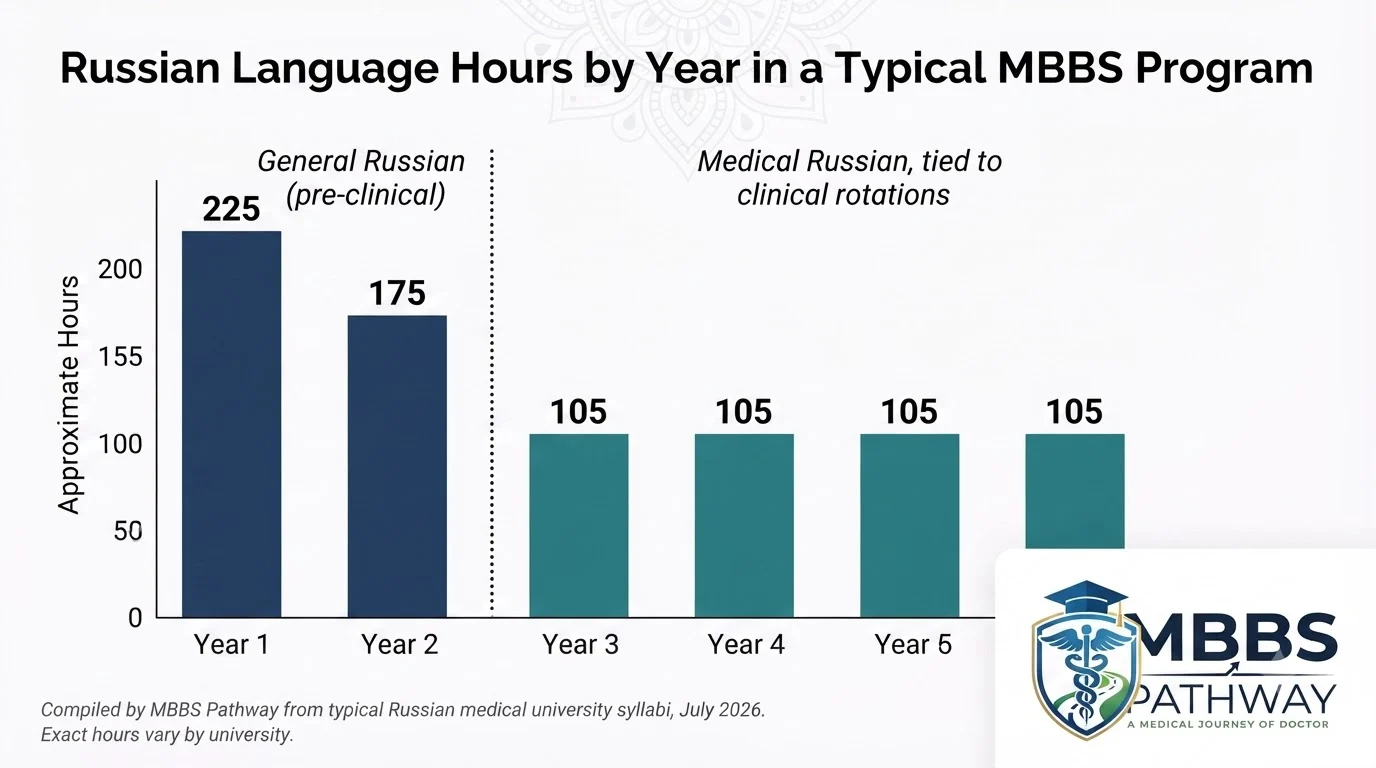
Even within the 25 or so English-medium universities, Russian doesn't disappear. It's built into the syllabus from year one, and it grows more important, not less, as you move toward clinical years. Here's roughly how it plays out:
- Year 1: around 200 to 250 hours of general Russian language instruction
- Year 2: around 150 to 200 hours, shifting toward medical vocabulary
- Years 3 to 6: about 2 to 4 hours a week, now woven directly into clinical rotations
So even in a "fully English" program, you're looking at hundreds of hours of Russian across the six years. That's not a footnote. That's a real part of the curriculum.
The Three Tracks — And Why Mixing Them Up Costs You
Once you look closely, Russian medical programs for international students actually split into three distinct tracks, and getting this wrong is one of the most common, costliest mistakes a family can make.
The first is a genuine English-medium program, where the full six years run primarily in English, with Russian taught alongside as a compulsory subject. The second is a bilingual program, where the first three years run in English and the balance shifts more heavily toward Russian once clinical training starts.
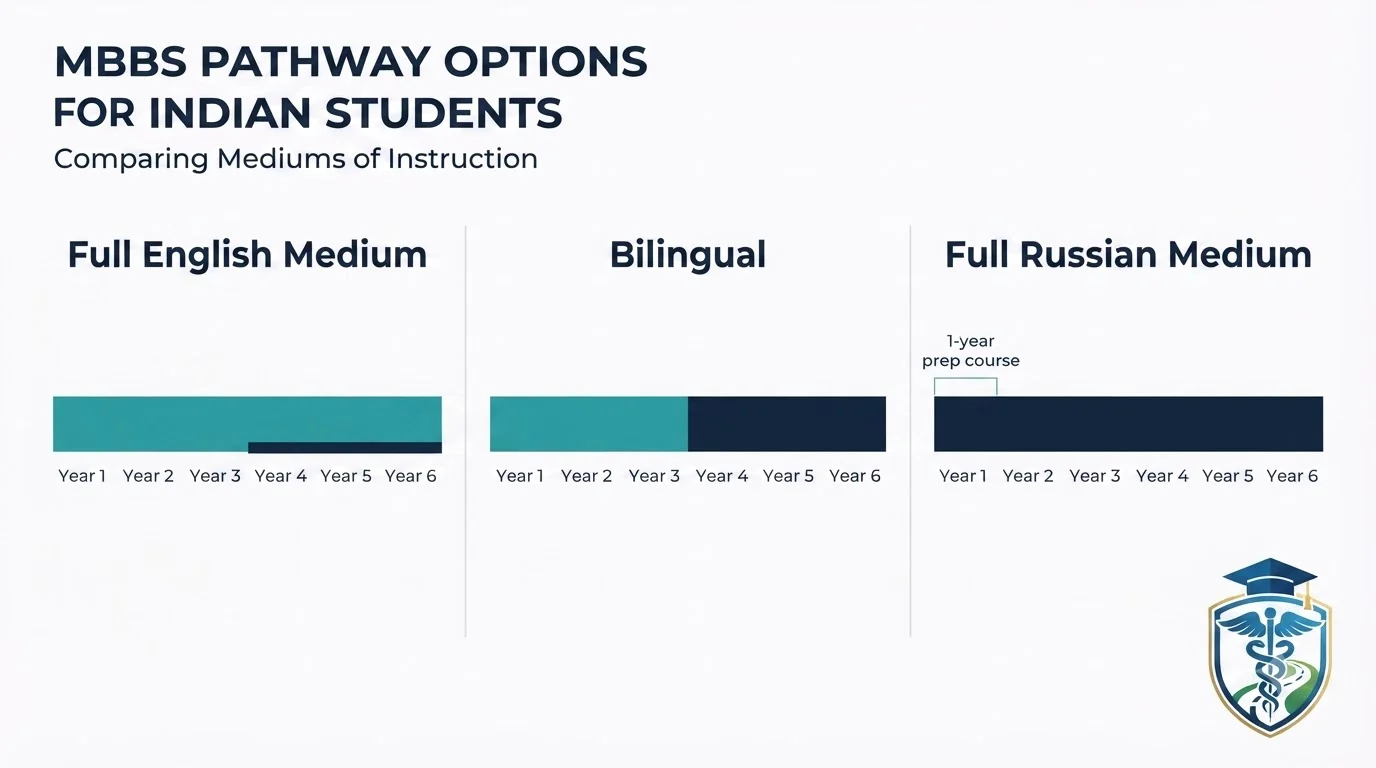
And the third is a fully Russian-medium program, taught in Russian from day one, often preceded by a one-year Russian preparatory course for international applicants.
Here's the problem we keep running into: some consultants describe all three of these, loosely, as "English medium," because technically some English is used somewhere in the process. That's not honest, and it's not harmless either. A family expecting Track 1 and landing in Track 3 is in for a genuinely difficult first year.
So ask directly. Get it in writing. Which of the three tracks is this specific offer for? It takes one email to confirm, and it can save you months of confusion later.
What Actually Happens in Years 4 to 6
This is the part brochures tend to gloss over. Once clinical rotations begin, usually from year three or four depending on the university, you're working in real hospitals, alongside real patients and real hospital staff. And most of those patients speak Russian, not English.
That means theory classes can stay in English right through to year six, technically fulfilling the "English medium" claim, while your actual bedside experience, the part that builds real clinical judgment, happens largely in Russian.

Without at least conversational fluency by this point, students often end up watching more than doing. That's not a small trade-off. Clinical exposure is exactly what makes the difference between a graduate who's ready for FMGE and one who isn't.
A realistic target here is conversational Russian, roughly a B1 to B2 level on the standard European scale, by the time clinical years begin. That's enough to take a patient history, follow ward instructions, and hold a basic conversation with hospital staff. You don't need fluency. You do need more than "hello" and "thank you."
Why This Isn't Just a Language Question — It's a Compliance Question Too
Here's something worth understanding, even though it needs a case-by-case check rather than a blanket rule. NMC's own regulations for foreign medical graduates require the medium of instruction to be English. If a university's clinical teaching quietly drifts into being conducted mostly in Russian, that's worth raising directly with the university, and it's a legitimate question to ask before you commit, not just an inconvenience to shrug off.
We're not lawyers, and this isn't legal advice. But it's exactly the kind of detail that's worth confirming for your specific university rather than assuming it away.
How We Verify This Before a Family Commits
In our experience, the fastest way to cut through the confusion is to just ask the university directly, in writing, and keep the answer on record. We ask exactly which of the three tracks the offer is for, how many compulsory Russian hours are built into years one through three, and what kind of language support exists once clinical rotations start. If a university can't answer clearly, that tells us something important on its own.
We started insisting on this after one too many calls from a family who'd been told "don't worry, it's all in English," only to find out months later that wasn't quite the full picture. We'd rather ask the awkward question upfront than have a student discover the gap the hard way in year four.
Can You Get By Without Learning Russian at All?
Honestly? For the first two or three years, in a genuine English-medium program, mostly yes. You can pass exams, follow lectures, and get through pre-clinical subjects without much Russian at all.
But we wouldn't recommend it. Clinical years arrive eventually, and they arrive faster than most students expect. Starting Russian seriously in year one, even just the compulsory coursework, puts you in a completely different position by year four than a student who treated it as optional. It's the difference between walking into your first ward round able to greet a patient and ask a basic question, versus standing there completely lost.
Frequently Asked Questions
Is MBBS in Russia taught in English?
Yes, but only at specific universities set up for it. Out of more than 70 medical universities in Russia, only around 25 are authorized to teach medicine in English to international students. The rest teach primarily in Russian. Always confirm which category your specific university falls into before you commit.
Is Russian language mandatory for MBBS in Russia?
It depends on your program track. In a fully Russian-medium program, yes, from day one. In an English-medium or bilingual program, Russian is still a compulsory taught subject, usually around 200 to 250 hours in year one, but it isn't required for passing your early-year exams.
How many hours of Russian do MBBS students actually study?
Roughly 200 to 250 hours in Year 1, focused on general Russian. Then 150 to 200 hours in Year 2, shifting toward medical vocabulary. From Year 3 onward, it's about 2 to 4 hours a week, integrated directly into clinical rotations. Exact hours vary by university, so it's worth confirming for the specific one you're considering.
Do I need Russian for clinical rotations?
In practical terms, yes. Theory classes in an English-medium program stay in English, but the patients and hospital staff you'll actually work with during clinical years mostly speak Russian. Without at least conversational Russian, clinical exposure tends to become observational rather than hands-on.
How many Russian medical universities teach in English?
Around 25 out of more than 70, according to Russian Education Group's own published figures. That means the majority of Russian medical universities are still primarily Russian-medium, which is exactly why this is one of the first things worth confirming before choosing a university.
What's the difference between English medium and bilingual MBBS programs in Russia?
An English-medium program runs the full six years primarily in English, with Russian taught as a subject alongside it. A bilingual program typically runs the first three years in English, then shifts more heavily to Russian for clinical years four through six. A fully Russian-medium program is in Russian throughout, often preceded by a one-year Russian preparatory course.
Can I survive MBBS in Russia without learning Russian at all?
In the first two to three years, largely yes, if you're genuinely in an English-medium program. From year four onward, it gets a lot harder, since clinical training means working with real patients who mostly speak Russian. We wouldn't recommend skipping the language altogether, even if it's technically possible for a while.
How do I check if a university's MBBS program is really English medium?
Ask the university directly, in writing, which of the three tracks, full English medium, bilingual, or full Russian medium, your specific offer is for. And ask how many compulsory Russian-language hours are built into years one through three. Get the answer on record before you pay anything.
What Russian proficiency level do I need by year 4?
A conversational level, broadly comparable to a B1 to B2 level on the standard European language scale, is a realistic and genuinely useful target. That's enough to handle patient interactions and ward rounds once clinical years begin.
Does not knowing Russian affect FMGE preparation?
Indirectly, yes. Students who get less hands-on patient exposure because of a language gap in clinical years often reach FMGE preparation with a thinner practical foundation, even when their theoretical knowledge is genuinely strong.
Is basic Russian enough, or do I need to be fluent?
Basic conversational Russian, enough to take a patient history and follow ward instructions, covers most day-to-day clinical needs. Full fluency isn't necessary for an MBBS student, though it certainly makes life easier.
Do all Russian universities teach Russian language as a compulsory subject?
In our experience, yes, virtually all of them do, even the fully English-medium ones, simply because clinical training requires it. The hours and intensity vary by university, but the subject itself is close to universal across the board.
Not sure which language track your shortlisted university actually falls into?
Get in touch for a free consultation, and we'll help you get it confirmed in writing before you commit to anything.
Get Your Free Consultation