
Call/WhatsApp: +91 88266 53638

Life of an Indian Medical Student Abroad — Hostel, Food, Safety, Climate, Homesickness & What No Consultancy Will Tell You (2026 Real Student Experiences)
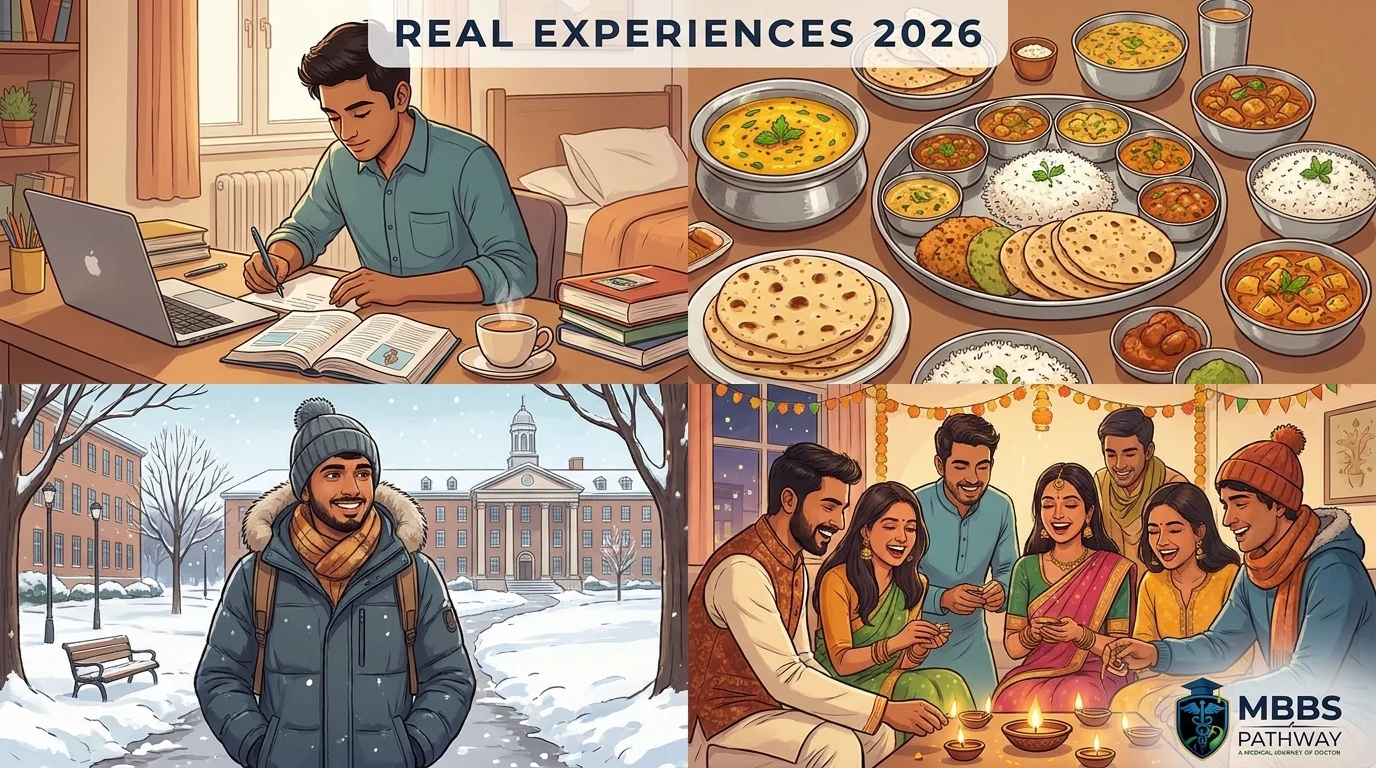
Quick Summary
- Indian MBBS students in Russia and Uzbekistan live in heated university hostels with Wi-Fi and 24/7 security.
- Indian food is available in all major MBBS cities — students cook at home and find Indian grocery stores nearby.
- Russian winters drop to -30°C outdoors, but rooms stay at a comfortable 22–24°C with central heating.
- Safety for girls: low-crime university cities, Indian student communities and MBBS Pathway safety-verified hostels.
- Monthly living cost in Russia: ₹16,500–26,000 — significantly lower than Indian private medical colleges.
No brochure shows you this part. And honestly, no consultant will either.
Every counselling session covers fees, university rankings and NMC approvals. But what happens after you land at Moscow Sheremetyevo with two suitcases? What does Tuesday morning look like? How do you get dal-rice in Kazan? Can you actually feel safe as a girl in Tashkent?
In our experience at MBBS Pathway — having guided hundreds of Indian students to Russia, Uzbekistan and beyond — these are the questions that keep parents awake and students anxious. So let's answer them all, honestly.
This isn't a sales pitch. It's what our students have actually told us. And if you're serious about the complete guide to MBBS abroad for Indian students, this is the piece you need to read alongside it.
Table of Contents
What Is Daily Life Like for Indian MBBS Students in Russia? (The Real Picture)
A typical weekday starts around 7:30 AM. You have lectures from 8 AM — anatomy, biochemistry or pathology depending on the year. Classes run till 2–3 PM. Afternoons are for self-study, labs or clinical rotations from Year 3 onwards. Evenings are your own.
The academic load is real. Russian medical universities don't let students drift. But it's manageable, and most students tell us the schedule actually helps them stay focused. There's a structure to the day that many students say they needed.
Weekends are when the real student life kicks in. Students explore the city, visit Indian restaurants, join the Indian student association events, or simply cook a proper meal together. The bond that Indian students form abroad is something else entirely — you're all in it together, and that creates a kind of friendship that lasts.
For the MBBS in Russia for Indian students — complete guide, we cover university-specific details including institutions like Sechenov University in Moscow. But day-to-day life is broadly similar across Kazan, Moscow and Volgograd.
Food — Indian Mess, Cooking, Eating Out (Country-by-Country Comparison)
This is the question every parent asks first. And we completely understand why.
The good news? You won't be surviving on instant noodles for six years.
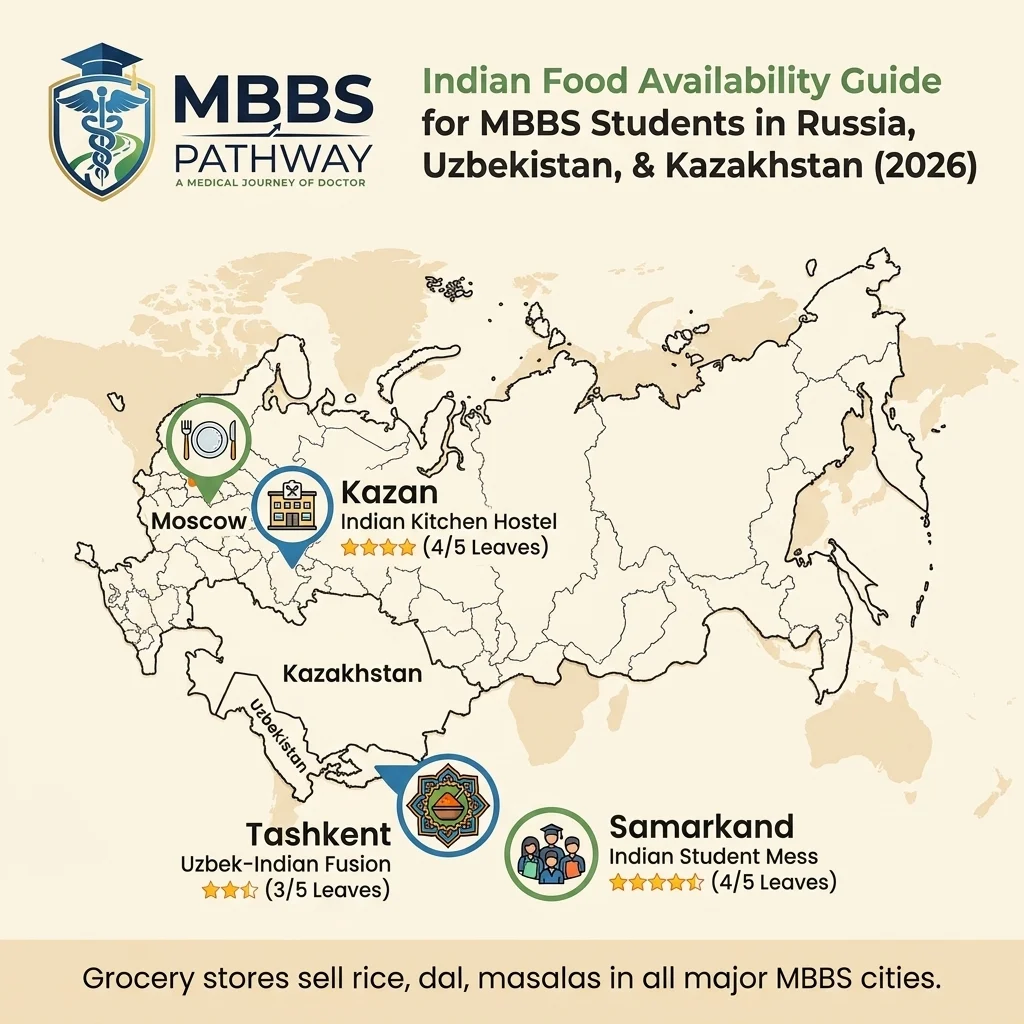
Indian Food Availability in Russia for MBBS Students
Moscow has multiple Indian restaurants and Indian grocery stores. You can get hing, jeera, haldi and even ready-to-cook masala packs. Kazan — one of our most popular MBBS Pathway partner cities — has an Indian kitchen facility in the partner hostel. Students cook together in batches. Volgograd has a student-run Indian mess that's been running for years. Rice, dal, sabzi, roti — all of it is available if you know where to go, and we make sure our students know exactly where to go from Day 1.
Indian Food Options in Uzbekistan and Central Asia
Uzbekistan is actually easier on the palate. The local cuisine is rice-based — plov (a rice and meat dish), bread, and grilled meats form the base. It's much closer to Indian food than, say, Russian or Eastern European cuisine. Tashkent and Samarkand have growing Indian food options, and popular restaurants like Raaj Kapur serve authentic Indian dishes. Universities like Samarkand State Medical University and hostel messes in Uzbekistan regularly serve dal and rice. For students who find Russian food a difficult adjustment, Uzbekistan is worth seriously considering. Our MBBS in Uzbekistan — fees and student life page covers this in more detail.
Hostel Life — Room, Wi-Fi, Utilities, Heating (Russia/Kazakhstan Winters)
Let's be very direct here. University hostels abroad are not five-star hotels. But they're far better than what many students imagine.
Standard hostel rooms are double or triple occupancy. Each room has single beds, study desks, wardrobes and access to shared bathrooms per floor. Wi-Fi is available in all MBBS Pathway partner university hostels — though a VPN is recommended for accessing certain apps and services. Monthly hostel cost runs between ₹8,000 and ₹15,000 depending on the city and university.
The one thing that surprises Indian students most: heating. Russian buildings have excellent central heating. When it's -25°C outside in January, the hostel room is a comfortable 22–24°C. You don't freeze indoors. You freeze for the five minutes it takes to walk from the hostel to the lecture block — and that's what the heavy jacket, thermals and boots are for.
From Year 2 onwards, students can choose to move into private shared apartments if they prefer more independence. But most of our students stay in hostels through Year 2 or 3, especially for the community and the lower cost.
Safety for Indian Students Abroad — Is It Safe for Girls? (Data by City)
We've seen this question in every parent consultation for the last several years. It's the most important question, and it deserves an honest answer — not a PR answer.
The concern is valid. The reality is reassuring.
Cities like Kazan (Russia) and Tashkent (Uzbekistan) consistently report lower violent crime rates than major Indian metros. Kazan is widely regarded as one of Russia's safest cities. Tashkent has a calm, low-crime environment that surprises most first-time visitors.
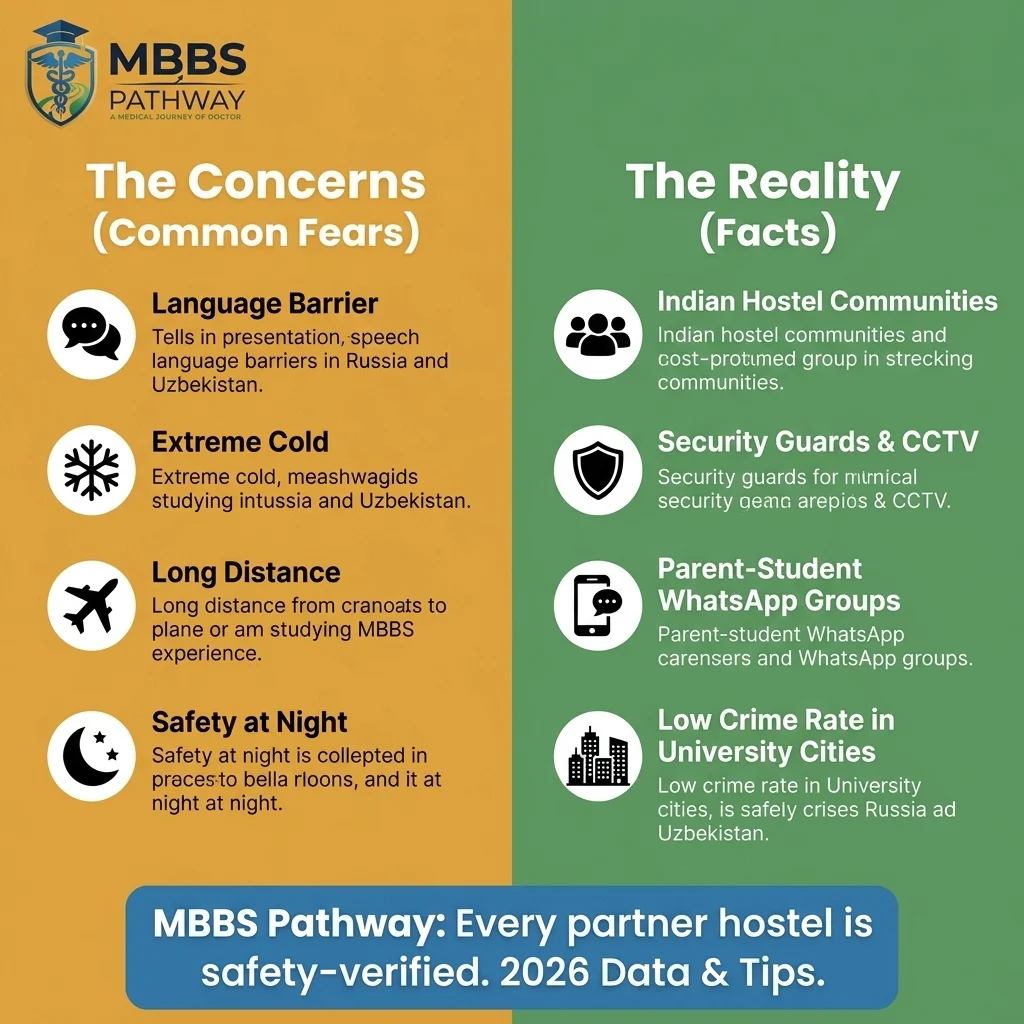
Here's what MBBS Pathway does specifically for safety:
- All partner hostels have 24/7 security guards and CCTV.
- Female students are housed on dedicated floors, not mixed floors.
- We set up city-specific Indian student WhatsApp groups before students arrive.
- Our on-ground contacts in each city are reachable 24/7 for the first semester.
- We advise all students — male and female — to use the buddy system for evening travel.
According to the India Ministry of External Affairs — travel advisory, Indian students in Russia should stay registered with the Indian Embassy and follow standard precautions. We help every student complete this registration before they leave.
Is it risk-free? No. But then, no city in the world is. The key is preparation, community and common sense — and on all three counts, our students are well equipped.
Book a free counselling session if you'd like to discuss safety in your specific destination city in detail.
Climate — How to Prepare for Russian Winters or Central Asian Summers
Russia. -25°C in January. Sounds terrifying, right?
Here's what our students actually say after their first winter: "It wasn't as bad as I thought." Not because -25°C isn't cold — it absolutely is. But because you're prepared, and because you're indoors for 90% of your day.
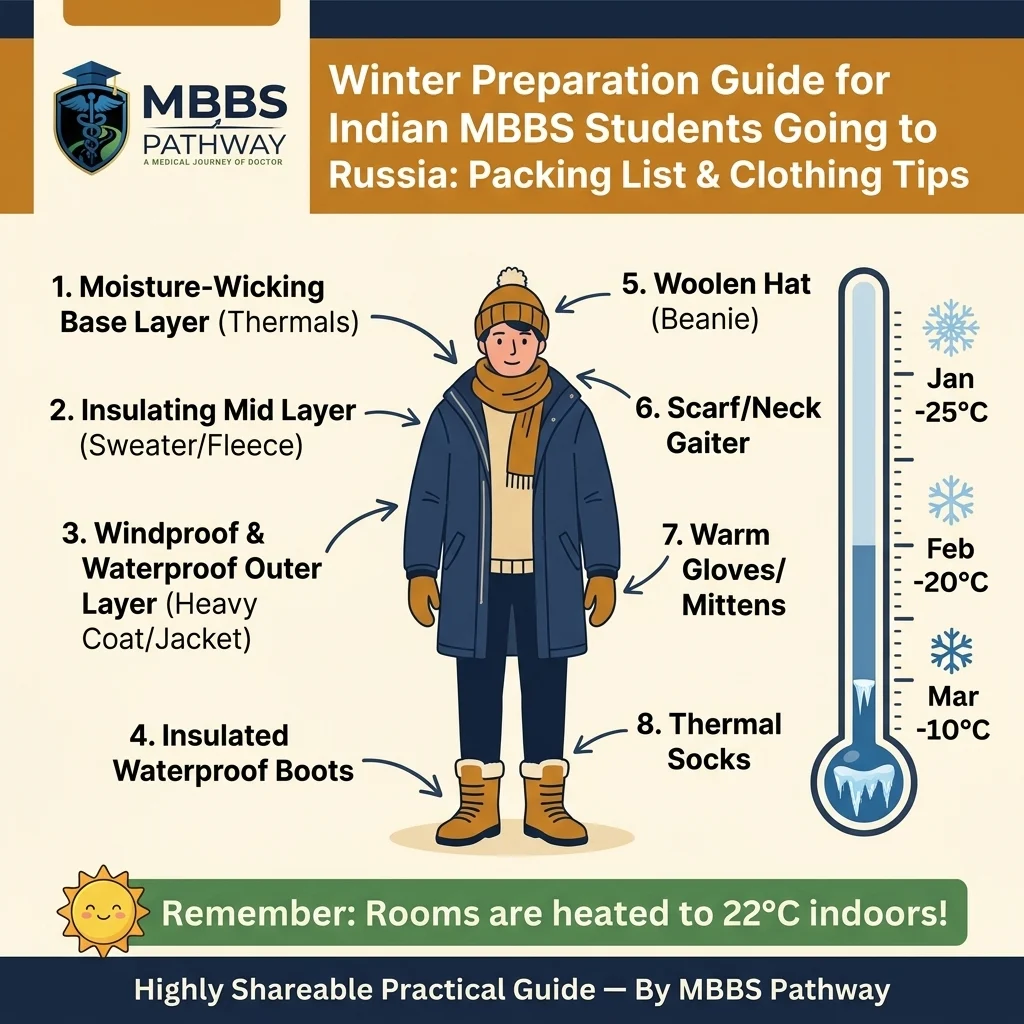
The Russian winter clothing system:
- Base layer: Thermal wear (top + bottom) — buy in India before you leave, it's cheaper.
- Mid layer: A thick fleece or woollen sweater.
- Outer layer: A proper down jacket rated for -30°C. Don't compromise on this.
- Accessories: Waterproof insulated boots, gloves, a woollen cap that covers your ears, and a scarf.
- Indoor: Once you're inside — hostel, university, metro — you strip down to normal clothes. The heating is that good.
Uzbekistan and Central Asia present a different challenge: summer heat. Tashkent summers hit 40°C+. Cotton clothing, hydration and sun protection are the priorities. Kazakhstan has an extreme continental climate — brutal winters and very hot summers. But in both cases, students adapt within a semester.
Language Barrier — How Bad Is It Really?
It's one of the top three fears. And it's one of the most overblown.
At all NMC-approved Russian universities, MBBS lectures are entirely in English. Your professors teach in English. Your exams are in English. Your textbooks are English. You don't need Russian to pass your MBBS — you need English.
Russian becomes relevant from Year 3, when clinical rotations begin and you interact with Russian patients. But universities prepare you for this. Free Russian language classes are included from Year 1. Most of our students reach conversational Russian — enough for clinical rounds — by the end of Year 2.
The biggest language challenge isn't the classroom. It's the supermarket, the pharmacy and the landlord. For this, our pre-departure orientation covers the 50 most useful Russian phrases, and our city-based student WhatsApp groups have senior students who help newcomers navigate daily life.
In Uzbekistan, the situation is even easier. English is more widely spoken in urban centres, and the growing number of Indian students has created a natural support ecosystem.
Managing Homesickness — Practical Tips from Students Who've Been Through It
Homesickness is real. Let's not pretend it isn't.
The first month is the hardest. Almost universally. You miss family meals, familiar roads, your own language around you. It's okay to feel that. Every student who's made it through their first semester felt it too.
But here's the thing — it passes. And it passes faster when you do a few specific things:
- Schedule a fixed weekly video call with family — same day, same time. It gives both sides something to look forward to.
- Cook Indian food with your flatmates — even once a week, the smell of tadka is genuinely therapeutic.
- Join the Indian student association within your first two weeks. Don't wait until you're lonely.
- Celebrate festivals, even small ones. Light diyas on Diwali. It matters more abroad than it ever did at home.
- Focus on the goal. Write it down and stick it on your desk. "I am going to be Dr. [Your Name]." That's why you're there.
MBBS Pathway's student support team does regular check-ins with first-year students, particularly in the first two semesters. We're here if things get tough.
How to Handle Money and Forex as an MBBS Student Abroad
Managing money from India while studying in Russia or Uzbekistan is simpler than it seems — but it needs planning.
Here's what we recommend, based on our experience:
For daily expenses: A multi-currency Forex card (Thomas Cook or HDFC Multi-Currency ForexPlus) is the most convenient option. Load it in India and use it like a debit card abroad. Exchange rates are generally better than cash conversion.
For larger transfers: SBI International or HDFC bank-to-bank transfer works well for tuition and hostel fee payments. Use the RBI forex guidelines for education payments as your reference for LRS (Liberalised Remittance Scheme) limits.
Emergency cash: Always keep 2–3 months of living expenses accessible as a backup. Things like a medical emergency or a delayed transfer can happen.
Monthly budget breakdown (Russia):
| Expense | Monthly Range (₹) |
|---|---|
| Hostel | ₹8,000 – ₹12,000 |
| Food | ₹5,000 – ₹8,000 |
| Transport | ₹1,500 – ₹2,500 |
| Personal | ₹2,000 – ₹3,500 |
| Total | ₹16,500 – ₹26,000 |
For detailed guidance on loans and forex, our education loan and forex support for MBBS abroad page covers bank-wise options, documentation and the complete process.
The Ultimate Packing Checklist for MBBS Abroad Students from India
Don't leave this to the last day. We've seen students arrive in Kazan in December without thermals. Don't be that student.
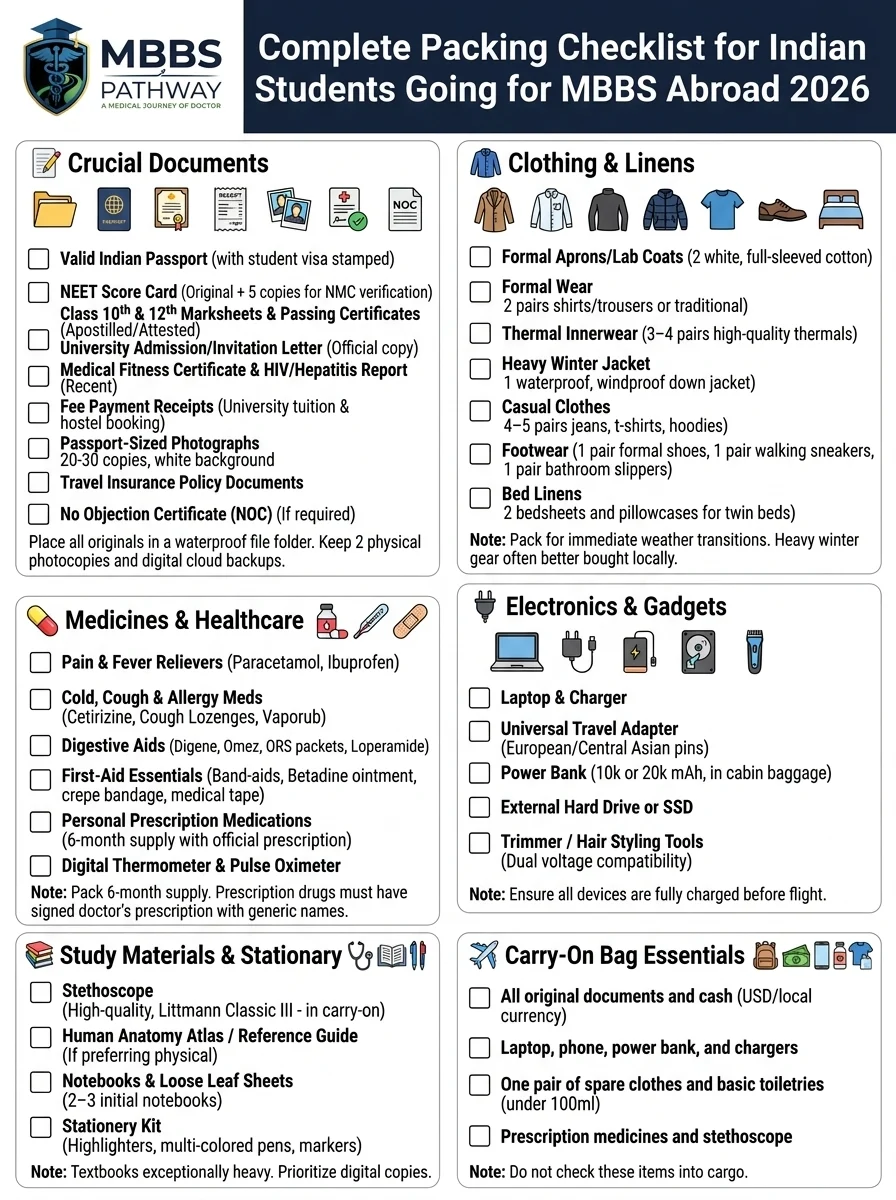
Documents (always carry originals + 2 certified copies of each):
- NEET scorecard
- 10th and 12th marksheets and certificates
- Passport (check validity — minimum 1.5 years remaining)
- Admission letter from the university
- Visa and invitation letter
- 20+ passport-size photographs (university needs a lot of these)
- Medical fitness certificate
- Student visa documents checklist
Clothing (for Russia — adjust for Uzbekistan/warm countries):
- 3–4 sets of thermal wear (top + bottom)
- 1 down jacket rated for -30°C
- Waterproof insulated boots (NOT regular sneakers)
- Woollen gloves, ear-covering cap, scarf
- Normal everyday clothing for indoors (rooms are warm)
Medicines (Indian home pharmacy — essential):
- Common OTC medicines: paracetamol, antacids, anti-diarrhoeals, antihistamine
- Personal prescription medications (6-month supply at minimum)
- ORS packets, Hajmola (genuinely useful abroad)
- Tiger Balm or pain relief ointment
Food items from India:
- Cooking masalas, dal, rice (2–3 kg for early days)
- Instant mixes (upma, poha, idli) for the first weeks
- Pickles, papads, dry snacks for the homesick evenings
Electronics:
- Good laptop (non-negotiable — all study material is digital)
- Universal power adapter (Type C / F / B plugs vary)
- Power bank
- Noise-cancelling earphones
Study materials:
- Core MBBS textbooks (Grey's Anatomy, Harrison's, etc.)
- Stationery, highlighters, sticky notes
- A physical planner (screens are distracting during revision)
Frequently Asked Questions — Life Abroad for Indian MBBS Students
Q1. Is MBBS abroad safe for Indian girls?
Yes. Cities like Moscow, Kazan, Tashkent and Samarkand have large Indian student communities and active support systems. MBBS Pathway partner hostels have security infrastructure, separate female floors, curfew guidelines and dedicated welfare contacts. Safety data in these university cities is comparable to — or better than — major Indian metros.
Q2. Is Indian food available in Russia for MBBS students?
Yes. Moscow, Kazan and Volgograd have Indian restaurants, Indian grocery stores and student-run Indian messes. At MBBS Pathway partner hostels in Kazan, Indian kitchen facilities are provided. Students regularly cook dal-rice-roti and get masalas and spices shipped from India without difficulty.
Q3. How cold is Russia in winter for Indian students?
Russian winters range from -15°C to -30°C between December and February in cities like Moscow and Kazan. However, indoor heating is excellent — hostels, classrooms and public spaces maintain 22–24°C. You feel the cold only during outdoor commutes. Proper layered clothing — thermals, a down jacket and waterproof boots — handles this well.
Q4. What is the monthly expense for an Indian MBBS student in Russia?
Monthly expenses in Russia: Hostel ₹8,000–12,000 + Food ₹5,000–8,000 + Transport ₹1,500–2,500 + Personal ₹2,000–3,500. Total: ₹16,500–26,000 per month. Annual living cost: ₹2–3 lakhs in addition to tuition. This is significantly lower than living costs at Indian private medical colleges.
Q5. Is there a language barrier for Indian MBBS students in Russia?
Lectures at National Medical Commission (NMC) approved Russian universities are entirely in English. Russian is needed only for patient interaction during clinical rounds, typically from Year 3. All universities provide free Russian language classes. Most Indian students reach conversational Russian by the end of Year 2. The barrier is manageable.
Q6. What should Indian students pack for MBBS in Russia?
Key items: Heavy winter clothing (thermals, down jacket, waterproof boots, gloves, cap), all original documents with certified copies, 6–12 months of personal medicines, Indian cooking essentials (masalas, dal), universal power adapter and a good laptop. MBBS Pathway provides a complete pre-departure checklist to every enrolled student.
Q7. How do Indian students manage homesickness during MBBS abroad?
Most students adjust within 2–3 months. Proven strategies: join the Indian student association within the first two weeks, cook Indian food together, schedule weekly fixed video calls with family, celebrate Indian festivals with the student community and write down your long-term career goal and keep it visible. MBBS Pathway's student support team offers ongoing pastoral care.
Q8. Is the hostel life good for Indian MBBS students in Russia?
MBBS Pathway partner university hostels have separate male and female floors, Wi-Fi, central heating, study rooms, basic kitchen facilities and 24/7 security. Double or triple occupancy is standard. Room quality has improved significantly over the past five years. Most students find hostel life comfortable and genuinely enjoy the community aspect of it.
Q9. What is the social life like for Indian students in Russia?
Indian student communities in major Russian university cities organise Diwali, Holi, Independence Day and other celebrations throughout the year. Active WhatsApp groups by city and university help students connect immediately. Weekend activities include city exploration, Indian restaurants and cultural events. The friendships formed during MBBS abroad tend to last a lifetime.
Q10. How can students handle money and forex while studying MBBS abroad?
Use a multi-currency Forex card (Thomas Cook or HDFC) for daily expenses. Use SBI International or bank-to-bank transfer for tuition payments. Keep 2–3 months of emergency cash accessible. Monthly remittance through standard banking channels is straightforward. Our education loan and forex support for MBBS abroad page covers every detail.
Q11. Is Uzbekistan safer than Russia for Indian MBBS students?
Both are safe for Indian students in university cities. Uzbekistan (Tashkent, Samarkand) is often perceived as slightly more comfortable due to no extreme cold, a rice-based cuisine familiar to Indian palates and a relaxed overall environment. Russia has a larger and more established Indian student community. MBBS Pathway recommends both destinations based on student preference and budget.
Q12. How do Indian MBBS students abroad prepare for NExT or FMGE while studying?
Year-round MCQ practice using Marrow and PrepLadder apps is most effective. Students prepare subject-wise alongside the university curriculum. Indian online coaching institutes offer National Exit Test (NExT) classes accessible from any country. MBBS Pathway provides year-wise NExT preparation guidance as part of its student support. The key advantage is starting from Year 1 — not leaving it for the final year.
For more detail, read our NExT exam preparation guide for MBBS abroad students.
Our Honest Take
We've been doing this long enough to know that no two students have the same experience abroad. Some thrive from Month 1. Others take a full semester to find their footing. But in our experience, the students who struggle the most are the ones who went in underprepared — not underskilled.
Preparation is everything. The right hostel, the right city, the right pre-departure briefing, the right community — these things change outcomes more than any brochure statistic does.
That's why MBBS Pathway does things differently. We visit partner universities. We talk to current students. We send you to cities where we personally know the situation on the ground. And we stay connected with you long after your flight departs.
If you're ready to take this seriously, let's talk. No pressure, no sales pitch. Just honest guidance.
Book a Free Counselling Session
Social Life, Making Friends and Indian Student Communities Abroad
You won't be alone. Not even for a week.
Indian student communities in major MBBS cities are active and well-organised. In Kazan alone, the Indian student population runs into the hundreds. Diwali celebrations, Holi events, Independence Day gatherings — these happen every year at partner universities. And they're not small, quiet affairs. They're proper celebrations that homesick students genuinely look forward to.
WhatsApp groups exist for every city, every university, and often every year-group. Senior students guide freshers on everything from which supermarket sells rice to which professor is best for anatomy. This community is one of the most underrated aspects of MBBS abroad, and we've found it makes an enormous difference to how quickly students settle in.
Social life does look different from India. There are no malls, no Starbucks on every corner, no Swiggy. But there's a different kind of richness — you explore a new culture, build genuine friendships under pressure and come back a different person. Most of our alumni say this was one of the most important growth experiences of their lives.