Call/WhatsApp: +91 88266 53638
NExT Exam 2026 Complete Guide for MBBS Abroad Students — Syllabus, Preparation Strategy, Country Pass Rates & How to Crack It First Attempt
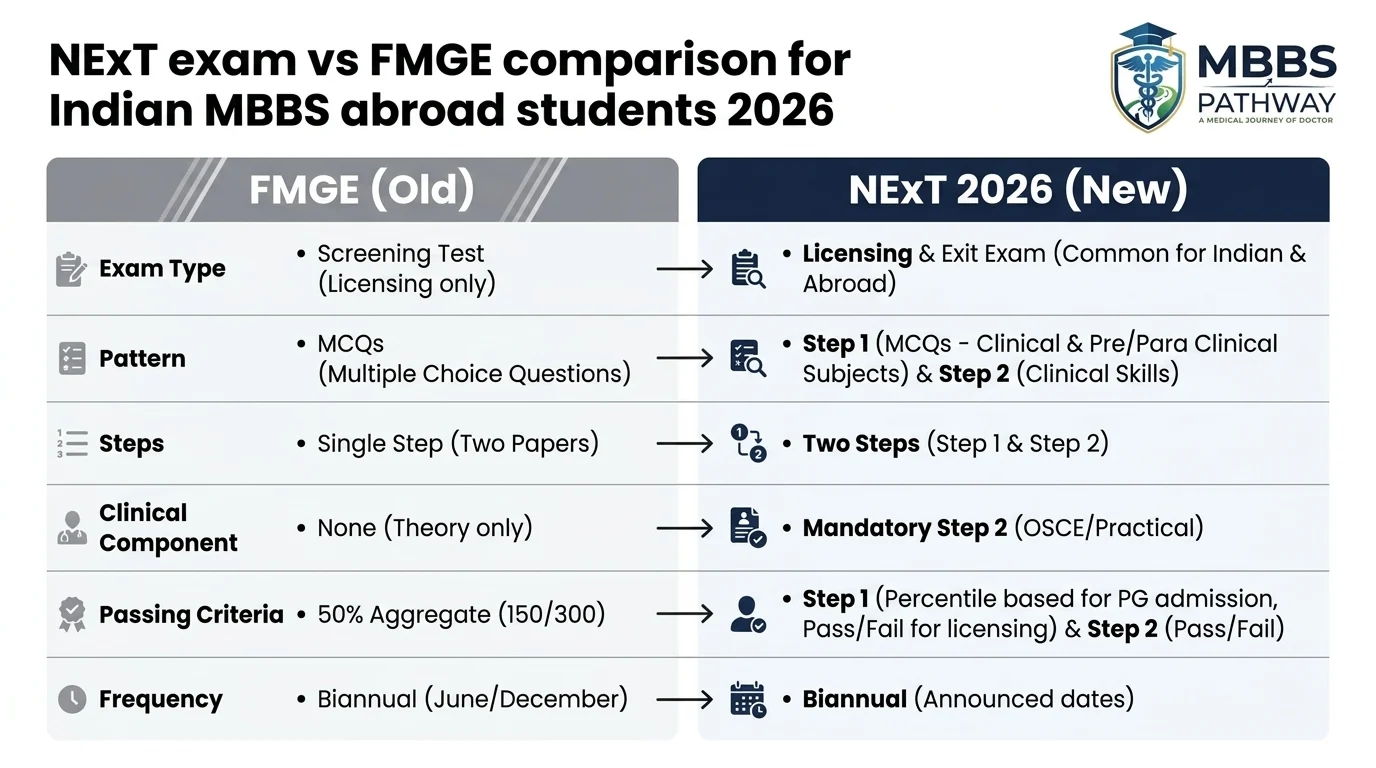
Important Highlights: NExT (National Exit Test) is set to replace FMGE for all MBBS graduates — Indian and foreign alike. As of May 2026, the NMC has confirmed NExT is postponed by 3–4 years. FMGE remains active. But smart students are already preparing for NExT from Day 1 of their MBBS. This guide covers everything — what NExT is, how it differs from FMGE, which countries give you the best preparation advantage, and a year-wise roadmap to clear NExT Step 1 on your first attempt.
If you're planning MBBS abroad — or you're already mid-MBBS in Russia, Uzbekistan, Georgia or anywhere else — the NExT exam is one thing you cannot afford to ignore. It's the single biggest shift in Indian medical licensing in the last two decades. And frankly, most students are simply not prepared for what's coming.
In our experience at MBBS Pathway, the students who crack NExT (and FMGE right now) are the ones who started planning early. Not in final year. Not after graduation. Early. That's what this guide is for.
We've also built this as the most complete NExT resource specifically for abroad students — because every competitor article out there is written for Indian MBBS students. The abroad student's situation is very different. And we'll explain exactly why.
Table of Contents
- What Is NExT Exam? How Is It Different from FMGE?
- NExT 2026 Exam Pattern, Syllabus and Eligibility
- Is NExT Exam Mandatory for MBBS Abroad Graduates?
- Latest Update — Is NExT Actually Happening in 2026?
- How Does University and Country Choice Affect Your NExT Preparation?
- Country-Wise NExT/FMGE Success Analysis
- Step-by-Step NExT Preparation Plan for MBBS Abroad Students
- NExT Coaching and Guidance from MBBS Pathway
- Frequently Asked Questions
What Is NExT Exam? How Is It Different from FMGE?
NExT stands for National Exit Test. The National Medical Commission (NMC) introduced it to create one single, uniform licensing standard for every MBBS graduate in India — regardless of where they studied.
Right now, MBBS abroad graduates take FMGE (Foreign Medical Graduate Examination) to get their Indian medical licence. It's a 300-question MCQ paper, conducted twice a year by NBEMS. But NExT changes all of this fundamentally.
Here's the core difference: FMGE only tests theory. It's a screening test, not a proper assessment of whether you can actually practise medicine. NExT fixes that by splitting the process into two steps.
- NExT Step 1 — theory-based, computer adaptive, MCQ and image-based questions. Covers all subjects from pre-clinical to clinical.
- NExT Step 2 — clinical skills assessment using OSCE (Objective Structured Clinical Examination) format. Real patient handling, clinical stations, procedural skills. This is what FMGE completely lacked.
And here's the big difference that most people miss: FMGE was only for foreign graduates. NExT will apply to EVERY MBBS graduate in India — both Indian college students and students who studied abroad. That means the exam is no longer a weaker "foreign student filter." It's the gold standard exit exam for the entire profession.
For MBBS abroad students, this matters enormously. You're now competing on the same paper as graduates from AIIMS, CMC and top Indian medical colleges. That's a different game altogether. The good news? It's winnable — if you start early.
Also refer to our complete guide to MBBS abroad for Indian students for a broader picture of what studying medicine abroad involves.
NExT 2026 Exam Pattern, Syllabus and Eligibility
NExT Step 1 is the theory exam. Here's what the syllabus looks like:
| Subject Group | Key Subjects |
|---|---|
| Pre-Clinical | Anatomy, Physiology, Biochemistry |
| Para-Clinical | Pathology, Microbiology, Pharmacology, FMT |
| Clinical | Medicine, Surgery, Paediatrics, OBG/Gynaecology, Orthopaedics, Ophthalmology, ENT, Psychiatry, Skin & DVL, PSM |
NExT Step 2 tests clinical competence using OSCE stations. Skills assessed include: history taking, clinical examination, procedural skills, communication, emergency management, and clinical reasoning.
Eligibility for NExT Exam
To appear for NExT, you must:
- Hold a recognised MBBS degree (from India or abroad)
- Complete the mandatory 12-month internship
- Have a valid NMC Eligibility Certificate (for foreign graduates)
- Graduate from a university on the NMC-approved list
For MBBS abroad students specifically, the NMC has tightened the rules further. Your foreign MBBS programme must be at least 54 months of academic study, followed by a 12-month internship at the same institution, and the course must be taught in English. No shortcuts, no exceptions.
Is NExT Exam Mandatory for MBBS Abroad Graduates?
Yes — and this is not optional. Once NExT is officially launched, every MBBS graduate who wants to practise medicine in India must clear both Step 1 and Step 2. This applies to Indian graduates and foreign graduates equally.
The NMC guidelines for MBBS abroad 2026 make this crystal clear. There is no exemption, no alternative pathway, and no grandfather clause for students who graduated before NExT was introduced.
So even if you graduated under the old FMGE system — once NExT replaces FMGE, it becomes the only route to Indian medical registration. This is why we tell every student: prepare for NExT standards from Year 1, even if FMGE is the exam you'll actually sit.
Latest Update — Is NExT Actually Happening in 2026?
This is where things get important — and where a lot of blogs are giving you outdated information.
As of early 2026, the NMC Chairman Dr Abhijat Sheth officially confirmed that NExT has been postponed by 3 to 4 years. The exam was originally planned to launch in August 2025. But due to significant implementation challenges and opposition from medical associations, the rollout has been pushed back.
So what does this mean for you right now?
FMGE continues as the active licensing exam. The June 2026 FMGE session is confirmed for 28 June 2026 at NBEMS. If you're a recent or upcoming MBBS abroad graduate, FMGE is what you're sitting — not NExT.
But — and this is critical — the NExT curriculum, standards, and clinical expectations are already shaping how NBEMS designs FMGE questions. The difficulty is creeping upward. So if you prepare for NExT-level standards, you'll clear FMGE comfortably. The reverse doesn't hold.
We strongly recommend our FMGE and NExT exam coaching page to understand exactly where your preparation should be right now.
How Does University and Country Choice Affect Your NExT Preparation?
This is the section no competitor has written — and it's probably the most important one in this guide.
Choosing where to do your MBBS abroad isn't just a cost decision. It directly affects how ready you'll be for NExT or FMGE when you graduate. And the differences between countries are significant.
Russia is the strongest choice for NExT preparation right now. Russian medical universities run a proper 6-year curriculum with deep pre-clinical foundations in Anatomy, Physiology and Biochemistry — the exact subjects that FMGE and NExT Step 1 hammer hardest. Many Russian universities also have dedicated FMGE coaching cells built into the curriculum. In our experience, students from Russia who prepared consistently throughout their course have a much smoother FMGE journey. See our detailed guide on MBBS in Russia for Indian students for university-specific details.
Uzbekistan is rapidly improving. Several universities there are actively updating their MBBS curriculum to align with NMC expectations. Clinical exposure quality has improved year on year. The key risk in Uzbekistan is variation — some universities have far better clinical facilities than others. University selection matters more in Uzbekistan than in Russia.
Georgia offers European-standard medical education and is the only MBBS abroad option in Europe within a reasonable budget. Clinical exposure is good, English medium is universal, and pass rates are decent. However, Georgia's curriculum sometimes underweights the Indian sub-subject distribution for FMGE/NExT. Students from Georgia often need additional MCQ coaching from Year 4 onwards.
Bangladesh is the most practical choice for students who want to stay close to India culturally, but FMGE pass rates from Bangladesh have historically been inconsistent.
The bottom line: English-medium instruction + strong pre-clinical curriculum + good clinical exposure = better NExT/FMGE outcomes. Russia leads on all three. Check the data below.
Country-Wise NExT/FMGE Success Analysis — Which Countries Produce Better Performers
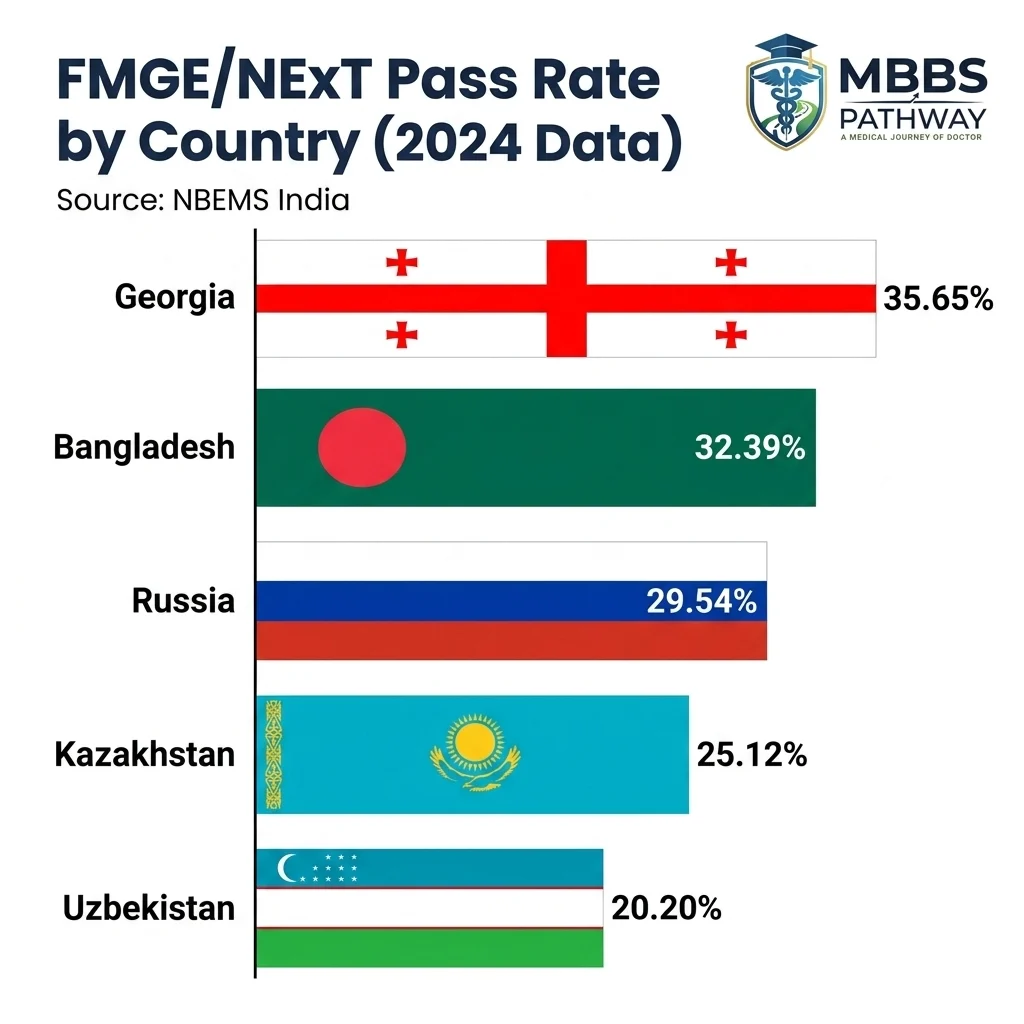
Bar chart comparing FMGE/NExT pass rates across Russia, Uzbekistan, Georgia, Bangladesh and Nepal — Source: NBEMS India 2024
The data below is based on FMGE 2024 performance (the most complete dataset available, as NExT is not yet live). These numbers reflect the real-world outcomes of students who studied in each country:
| Country | FMGE Pass Rate (2024) | English Medium | Clinical Exposure Quality | NExT Readiness Index |
|---|---|---|---|---|
| Russia | ~18–22% | Partial–Full | High | ⭐⭐⭐⭐ |
| Georgia | ~15–19% | Full | Medium–High | ⭐⭐⭐½ |
| Uzbekistan | ~10–15% | Partial–Full | Medium (improving) | ⭐⭐⭐ |
| Kazakhstan | ~10–14% | Partial | Medium | ⭐⭐½ |
| Bangladesh | ~8–12% | Full | Medium | ⭐⭐ |
| Nepal | ~9–13% | Full | Medium | ⭐⭐ |
Note: These pass rates include all appearing candidates — not just those who prepared seriously. In our experience, students with consistent 6-year MCQ preparation from these countries, regardless of location, significantly outperform these averages.
One important nuance: pass rate data from NBEMS is often aggregate and doesn't isolate students who prepared well from those who didn't prepare at all. The country you choose matters — but your preparation habits matter more.
Also read our detailed breakdown of FMGE pass rate by country 2025 for a deeper data analysis.
Step-by-Step NExT Preparation Plan for MBBS Abroad Students — Year 1 to 6
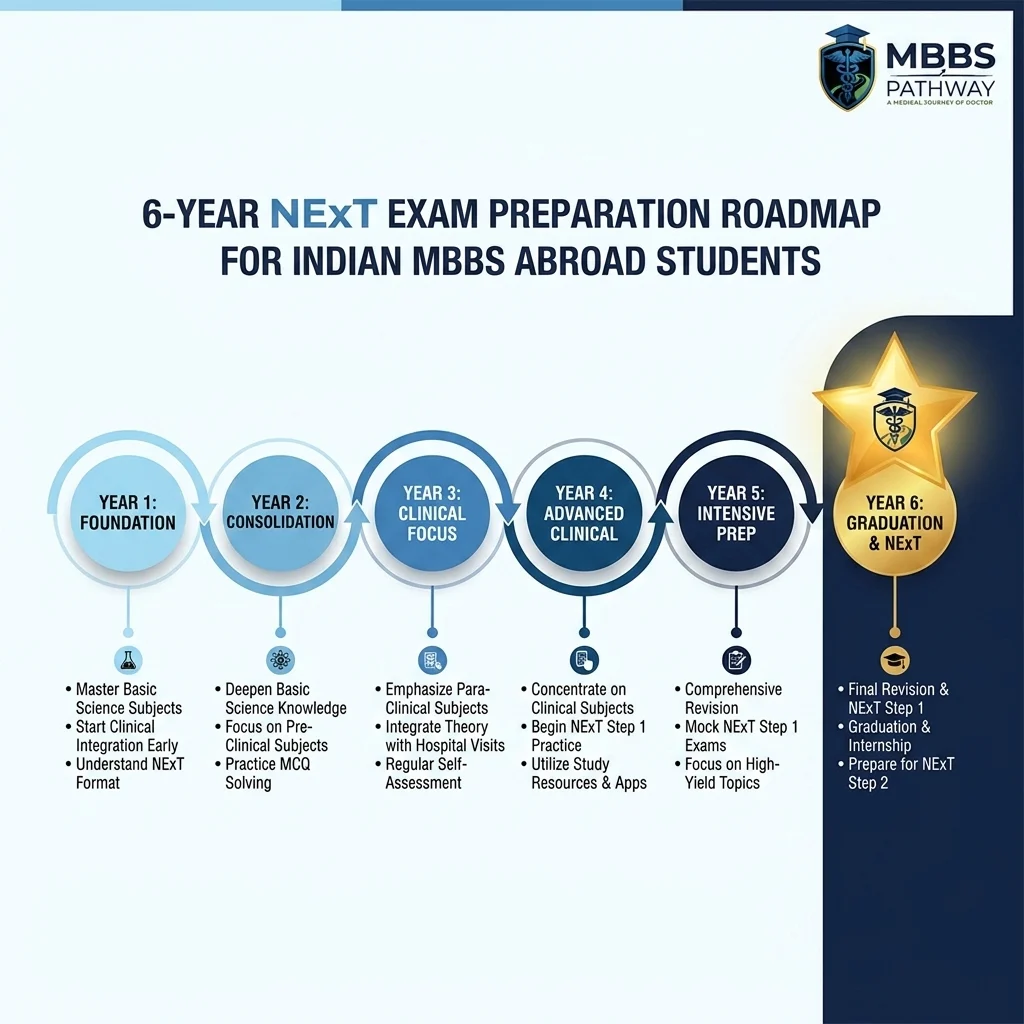
Year-by-year NExT and FMGE preparation roadmap for MBBS abroad students — designed by MBBS Pathway
This is the section that no competitor offers for abroad students. A year-wise plan. Not a generic "study harder" advice article. A real, actionable roadmap.
Year 1 — Build the Foundations Right
Year 1 is when everyone is adjusting to a new country, a new language, new food. We get it. But don't let Year 1 be a complete academic wasteland.
Focus on Anatomy, Physiology and Biochemistry. These three subjects account for a massive chunk of FMGE/NExT Step 1 marks. Many students who struggle later trace it back to a weak Year 1 foundation. Use BRS Physiology and Snell's Anatomy alongside your university textbooks. Start recognising that you're learning for two exams — the university exam and NExT.
Year 2 — First Contact with MCQ Practice
Start solving subject-wise MCQs from Year 2. This sounds aggressive but it's not — it's strategic. You don't need to do full papers. Just 20–30 MCQs per subject after completing each chapter. Download Marrow or PrepLadder — both apps have offline modes and are accessible from Russia, Georgia, Uzbekistan, everywhere.
Also, Year 2 is when Pathology and Microbiology begin. Robbins Pathology is non-negotiable. Read it chapter by chapter. DM Vasudevan for Pharmacology is excellent for exam alignment.
Year 3 to 4 — Clinical Subjects Begin
Medicine, Surgery, OBG, Paediatrics, Psychiatry — these start here. Alongside your regular coursework, start reading Harrison's Principles of Internal Medicine for Medicine and Bailey & Love for Surgery. These are the gold-standard books that FMGE/NExT questions draw directly from.
By end of Year 4, you should have at least 1,000–1,500 MCQs solved across subjects. Use spaced repetition actively. PrepLadder's AI-based revision is excellent for this.
Year 5 — Intensive MCQ Drilling
This is the year to get serious. Dedicate 2–3 hours daily to MCQ practice alongside your regular coursework. Start full-length mock tests. Identify weak subjects and attack them directly. FMGE previous year papers (2018–2025) are gold — solve them all, then analyse every wrong answer.
A lot of Russian MBBS students also start attending online FMGE coaching from India in Year 5. Platforms like Marrow and PrepLadder now have structured 6-month and 12-month courses accessible remotely.
Year 6 (Final Year) — Full Exam Mode
By Year 6, your MBBS studies and your exam preparation must run in parallel. Enrol in a structured FMGE/NExT coaching programme. Take at least 3–4 full-length mock exams per month. Review your scores, track patterns and fix weaknesses systematically.
Most importantly — don't wait till after graduation to start. Students who begin serious preparation only after graduation typically need 6–12 months of dedicated study post-degree. That's 6–12 months of your career delayed. The students who prepare through Year 6 are writing FMGE within weeks of graduation.
Get a personalised year-wise NExT/FMGE preparation plan based on your current year and country.
Best Books for NExT Step 1 Theory Preparation
We've seen students overwhelm themselves with too many books. Don't do that. Stick to these:
- Anatomy — Snell's Clinical Anatomy, BD Chaurasia (for MCQ focus)
- Physiology — BRS Physiology, Ganong's Review
- Pathology — Robbins & Cotran (chapters first, then MCQs)
- Medicine — Harrison's Principles of Internal Medicine
- Pharmacology — KD Tripathi, DM Vasudevan (for quick revision)
- OBG — DC Dutta's Obstetrics, Shaw's Gynaecology
- Surgery — Bailey & Love, Sabiston (for reference)
Best Apps and Online Resources for NExT Preparation
Three platforms dominate serious NExT/FMGE preparation in India:
- Marrow — Built specifically for FMGE and NEET PG/NExT. Huge question bank, detailed explanations, strong video lectures. India's most-used medical exam platform.
- PrepLadder — Excellent AI-driven adaptive learning. Their subject-wise modules are particularly strong for clinical subjects. Also accessible from abroad without any issues.
- DAMS Online — Delhi Academy of Medical Sciences offers an online version of their coaching. Particularly strong for students who want a more structured, classroom-like experience remotely.
All three are accessible from Russia, Uzbekistan, Georgia — anywhere you're doing your MBBS. Download content for offline use during exams or when internet is slow.
NExT Coaching and Guidance from MBBS Pathway
At MBBS Pathway, we don't just help you get into a medical university abroad. We stay with you through the entire journey — including your FMGE and NExT preparation.
In our experience working with hundreds of MBBS abroad students, the ones who struggle most are those who were never given a clear preparation roadmap. Their consultancy helped them get admission and then disappeared. That's not how we work.
Our post-admission support includes:
- Year-wise NExT/FMGE study planning — customised for your university, country and year
- Recommended resource lists — books, apps and coaching programmes that actually work
- Mock test scheduling guidance — when to start, how many to take and how to analyse results
- Connection to NBEMS-aligned coaching programmes — both online and offline options
- Direct counselling on the NExT vs FMGE situation — we track every NMC update and pass them to you immediately
And yes — we offer a free 30-minute counselling session to discuss your NExT strategy, no strings attached. Whether you're in Year 1 abroad or you just graduated, we'll tell you exactly where you stand and what to do next.
Also check our FMGE and NExT exam coaching page for full details on our preparation support programmes.
Frequently Asked Questions — NExT Exam for MBBS Abroad Students
Is NExT exam mandatory for MBBS abroad students who want to practise in India?
Yes — NExT will be mandatory for all MBBS graduates including foreign medical graduates once it launches. As of May 2026, NExT is postponed by 3–4 years. FMGE remains the active licensing exam. Students graduating now must clear FMGE. Once NExT officially launches, it replaces FMGE entirely.
What is the difference between NExT and FMGE?
FMGE is a single 300-question MCQ test for foreign medical graduates only. NExT, when launched, applies to all MBBS graduates — Indian and foreign both. NExT has two steps: Step 1 (theory MCQs) and Step 2 (clinical skills via OSCE). The clinical component is what FMGE completely lacked. NExT sets a much higher standard.
When is the NExT exam 2026 for MBBS abroad graduates?
NExT has been officially postponed for 3–4 years as of early 2026. FMGE is the currently active exam. The next FMGE session is confirmed for 28 June 2026. Check NBEMS.edu.in for official scheduling. MBBS Pathway sends exam date alerts to all registered students — book a free session to stay updated.
Which country's MBBS gives the best NExT preparation advantage?
Russia consistently leads. Its 6-year curriculum, strong pre-clinical depth and expanding NExT coaching ecosystem make it the best-positioned country for NExT outcomes. Uzbekistan is improving fast. Countries with English-medium teaching and solid clinical exposure — Russia, Georgia — consistently outperform others in FMGE results, which directly predicts NExT readiness.
How do I prepare for NExT while studying MBBS abroad?
Start MCQ practice from Year 2. Use Marrow or PrepLadder throughout your 6 years. Harrison's for Medicine, Robbins for Pathology, DC Dutta for OBG. Add Indian author revision books (Arvind Arora, DM Vasudevan) for exam alignment. Contact MBBS Pathway for a personalised year-wise preparation plan tailored to your country and year.
Is NExT harder than FMGE for foreign medical graduates?
Yes, NExT will be harder than FMGE. It adds a clinical skills Step 2 (OSCE) that FMGE never had. However, NExT Step 1 pass rates may actually normalise compared to FMGE — because Indian graduates also sit the same paper, spreading the curve more fairly. Starting preparation early is still the decisive advantage.
Can I give NExT exam while still studying MBBS abroad?
No — NExT is only for graduates who have completed their MBBS degree and mandatory internship. You cannot appear mid-course. But NExT preparation absolutely must begin from Year 1. MBBS Pathway's coaching support is available for both current MBBS abroad students and those preparing post-graduation.
What subjects are covered in NExT Step 1?
NExT Step 1 covers all MBBS subjects: Anatomy, Physiology, Biochemistry, Pathology, Microbiology, Pharmacology, FMT, Medicine, Surgery, Paediatrics, OBG & Gynaecology, Orthopaedics, Ophthalmology, ENT, Psychiatry, Skin & DVL, and PSM. It's a comprehensive exit examination covering the full MBBS curriculum.
How many attempts are allowed for NExT exam?
NBEMS has not yet specified a fixed attempt limit for NExT as of 2026. Under FMGE, there's no official attempt limit either. However, multiple attempts delay your medical career significantly — sometimes by years. MBBS Pathway recommends treating your first attempt as your only attempt. Consistent 6-year preparation is the reason students clear it first time.
What happens if I fail FMGE or NExT?
You cannot practise medicine in India until you clear the licensing exam. Failing adds months — sometimes years — to your career start. During the gap, you can re-appear in the next FMGE/NExT cycle (conducted twice a year). Use that time for intense coaching. MBBS Pathway has helped students who failed FMGE the first time to clear it decisively on their next attempt with a structured plan.
Does MBBS Pathway offer NExT exam coaching or preparation support?
Yes — absolutely. MBBS Pathway offers NExT and FMGE preparation guidance as part of its complete post-admission support. This includes year-wise study planning, curated resource lists, mock test scheduling, and connections to NBEMS-aligned coaching programmes. Book a free counselling call to discuss your NExT preparation strategy with our team.
Is NEET score required to appear for NExT exam?
NEET qualification is required before you're eligible to study MBBS abroad, and your MBBS degree from a foreign university must be NMC-recognised. Without these, you cannot appear for NExT or FMGE. The NMC has confirmed that NEET qualification is non-negotiable for Indian students pursuing MBBS abroad — and therefore, for NExT eligibility too.
Questions about NExT? Talk to us directly.