Call/WhatsApp: +91 88266 53638
NMC guidelines for MBBS abroad 2026 — what changed, what it means for you
📋 NMC Regulations — Updated April 2026
Let me start with the most important thing you need to understand about NMC rules. Most students think NMC maintains an "approved university list" — they don't. What NMC maintains is an approved set of rules. If a university meets those rules, your degree is valid. If it doesn't, it's not — regardless of what any consultant tells you.
What Is NMC and Why Does It Matter for MBBS Abroad?
The National Medical Commission replaced the old Medical Council of India (MCI) in September 2020. It's the top regulatory body for medical education in India. NMC decides who can and who can't practise as a doctor in India — full stop. If NMC doesn't recognise your degree, you simply cannot get registered, and you cannot practise.
For MBBS abroad students specifically, NMC issued the Foreign Medical Graduate Licentiate (FMGL) Regulations on November 18, 2021. That document is the rulebook that governs everything — from NEET eligibility and course duration to internship requirements and licensing exams. Every Indian student planning to study MBBS abroad must understand this document.
But NMC doesn't stop there. They keep issuing advisories, clarifications, and new notices throughout the year. Staying current with all of this is one of the most important things a genuine MBBS consultant does. In my experience, the consultants who are most dangerous to students are the ones still advising on 2019-era rules in 2026.
🔗 External Verification
Always cross-check regulations on the official NMC website: nmc.org.in — For Students Planning to Study Abroad. Don't rely on secondhand summaries — including this one — without checking the source.
NMC 2024–2026 Circular Updates — What Actually Changed?
There's been a lot of noise about NMC rule changes in the last two years. Some of it is accurate. Some of it is exaggerated or misunderstood. So let me break down the actual, confirmed changes and separate them from the speculation.
What Changed — Confirmed Updates
Change 1
Online Study Compensation Rule (March 6, 2026)
Students who completed any MBBS coursework online (primarily COVID-era, 2020–2022) must now complete equivalent offline, in-person training at the same foreign university. The university must issue a certificate authenticated by the Indian Embassy confirming completion.
Change 2
Two Years Cannot Become One (March 2026 Clarification)
NMC specifically clarified that two academic years of missed offline study cannot be completed in one year. The timeline must match course duration requirements. No shortcuts — even for pandemic-related absences.
Change 3
Softened Stance After Student Protests (March 18, 2026)
Following protests from All India Medical Students Association (AIMSA-FMSW) and other organisations, NMC withdrew an earlier strict version of the compensation mandate. The revised position adopts a more pragmatic approach — recognising that online study during COVID was not optional for students.
Change 4
Draft FET Exam Announcement (2025–2026)
NMC proposed a new Foreign Eligibility Test (FET) that students would take before going abroad — a first-year MBBS-level exam. As of April 2026, this is still in draft/gazette form. No implementation date has been confirmed. Watch this space closely.
Change 5
NExT Deferred for 3–4 Years
The much-discussed NExT exam — planned to replace both FMGE and NEET-PG — has been deferred. FMGE continues as the mandatory licensing exam for foreign graduates. NExT pilot exams may happen in 2026–2027, but full rollout isn't expected before 2028–2029.
Change 6
Stricter Advisory on Non-Compliant Colleges (2025–2026)
NMC's UGMEB has repeatedly issued advisories warning against colleges that violate intake capacity, don't provide sufficient clinical exposure, or operate offshore campus models outside regulatory oversight. These advisories keep coming because the problem hasn't stopped.
What Has NOT Changed — The Core Rules Still Stand
The core FMGL Regulations 2021 remain in full force. These are the non-negotiables. Breaking any single one means your degree won't qualify you for FMGE/NExT registration.
| Rule | Requirement | Status in 2026 |
|---|---|---|
| NEET Qualification | Mandatory for all Indian/OCI students; valid for 3 years | Unchanged — strictly enforced |
| Course Duration | Minimum 54 months (4.5 years) of academic study | Unchanged |
| Internship Location | 12 months in the SAME country & university — no split | Unchanged — no exceptions |
| Medium of Instruction | English medium only — exams and academics | Unchanged |
| Clinical Training | Hands-on in core subjects; no online-only programs | Unchanged + strengthened |
| Country Registration | Students must be legally allowed to practice in that country | Unchanged |
| FMGE / NExT Exam | Must clear before Indian medical registration | FMGE continues; NExT deferred |
| Online Education | Not accepted; compensation training now required | New March 2026 rule added |
NMC-Approved Countries and Universities — The Right Way to Understand This
Here's a common misconception I want to clear up: NMC doesn't publish a list of "approved universities" the way many people believe. What they used to publish — the old MCI list — was based on information from Indian embassies and is explicitly stated to be non-endorsement. The 2021 FMGL Regulations moved away from a list-based system to a criteria-based one.
This is both good and bad news. It's good because it forces universities to maintain genuine standards rather than just lobbying for a list entry. But it's bad because it puts the verification burden squarely on students and their families.
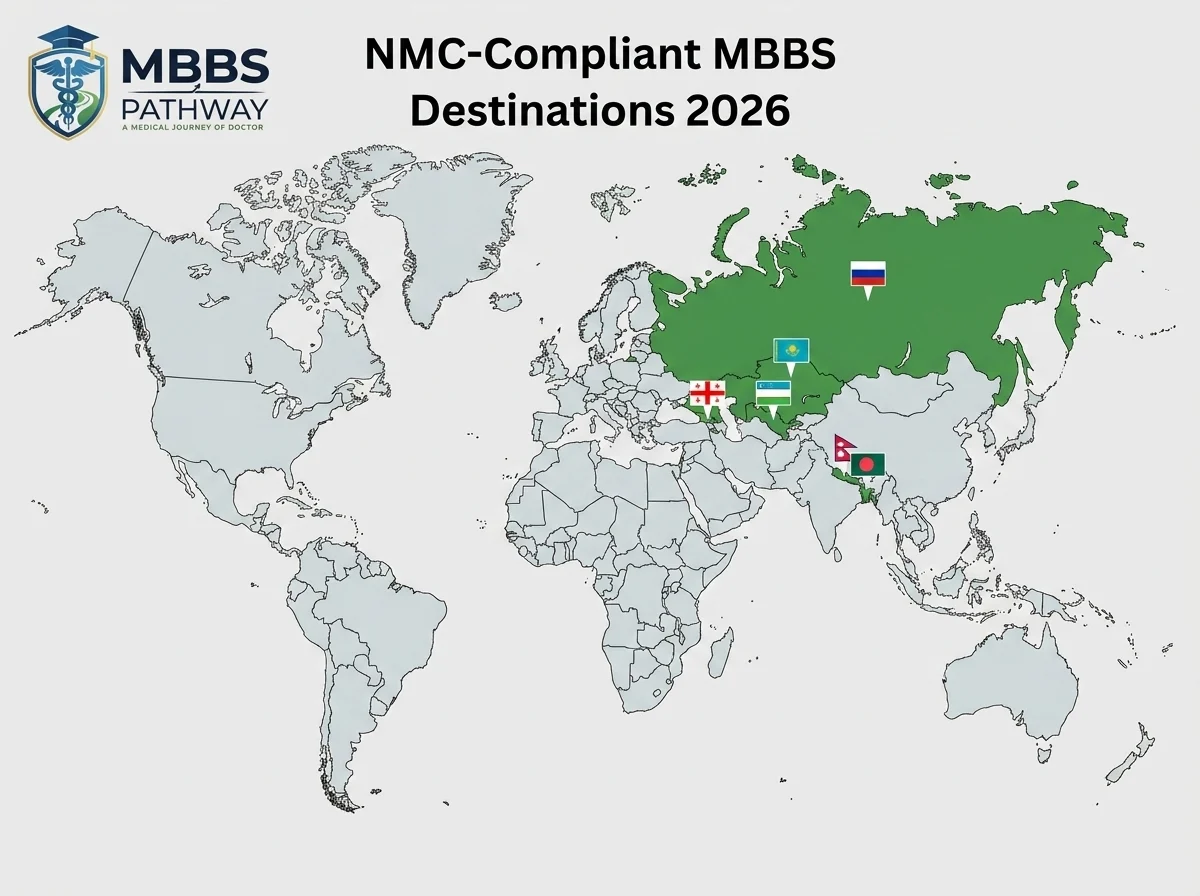
Countries Where Compliance Is Most Consistent
Based on patterns I've observed with thousands of students, the following countries have a stronger track record of offering MBBS programs that meet NMC's criteria. But this is not a guarantee — always verify the specific university.
- Russia — 6-year English-medium programs; most universities list students in WDOMS; strong FMGE history. Read our complete Russia guide →
- Georgia — Growing destination; Georgian universities increasingly popular post Ukraine-Russia war disruption; check individual university WDOMS status
- Kazakhstan — Established programs; affordable fees; some universities have excellent FMGE outcomes
- Uzbekistan — Rapidly improving; newer programs should be checked more carefully for WDOMS listing and English-medium compliance
- Bangladesh — Closest option; some universities have very strong FMGE pass rates; proximity makes parental visits easier
- Nepal — Same advantage as Bangladesh; popular for students who prefer a more familiar environment
⚠ Important Caution
China, Philippines, and Kyrgyzstan have produced mixed results in recent years. Some universities in these countries do comply with NMC norms — but several do not, particularly around English-medium instruction and clinical exposure standards. Any decision involving these destinations requires especially careful due diligence.
How to Verify If a Foreign University Is NMC-Approved — Step by Step
This is the single most important set of steps in this entire guide. Don't skip a single one. And don't rely on your consultant's word alone — do this yourself.
- Visit WDOMS — World Directory of Medical Schools. Go to wdoms.org and search for the exact university name. Verify that the listing shows "Recognition/Accreditation" status as valid in the country where the university is located. A WDOMS listing is a minimum requirement — but not sufficient alone.
- Check NMC's official information portal. Visit nmc.org.in and go to the "For Students to Study Abroad" section. Read the current eligibility criteria and check any specific university notices or warnings NMC has issued.
- Verify English-medium instruction directly. Email the university's admissions office using the address on their official website — not one your consultant provides. Ask: "Is the entire MBBS curriculum, including clinical rotations and examinations, conducted in English?" Get a written response.
- Confirm the 54-month academic duration. Ask for the university's official course structure document showing semester-wise duration. It must total at least 54 months of academic training before the 12-month internship.
- Verify the internship is at the same institution. Ask whether the mandatory 12-month internship is conducted at the same university's affiliated hospitals. Split internship or cross-country arrangements are not accepted by NMC.
- Confirm that Indian students can legally practice in that country. This is a less-known requirement. NMC states that the country must grant Indian students the right to practice medicine there — not just to study. Check with the Indian Embassy in that country for confirmation.
- Contact the Indian Embassy in the destination country. The NMC itself recommends this step. Indian embassies can often confirm whether a specific institution meets the requirements for NMC recognition in India.
- Talk to current students — not just online reviews. Ask your consultant for direct WhatsApp contact with at least two or three students currently studying at the university. Third- or fourth-year students give the most useful real-world picture.
I know this seems like a lot. But think about it this way: you're about to commit ₹20–₹40 lakh and six years of your life. Spending three days doing this research is not excessive — it's essential.
NExT Exam — Replacing FMGE? Here's the Real Story
I've seen so many students panic about this, so let me be very direct: as of April 2026, FMGE is still the mandatory licensing exam for foreign medical graduates. NExT has been deferred by 3–4 years. If you're currently studying abroad and planning to return by 2027 or 2028, FMGE is most likely the exam you'll appear for.
That said, NExT is coming eventually. And it will be a bigger deal. Here's a plain-English comparison of both.
FMGE Current
- 🎯 Conducted by: National Board of Examinations (NBEMS)
- 📅 Frequency: Twice a year (June & December)
- 📝 Format: 300 MCQs, computer-based, single day
- ✅ Passing mark: 150/300 (50%)
- ⚠ Pass rate: ~23% (December 2025)
- 🔄 Attempts: Unlimited
- ❌ Negative marking: -0.25 per wrong answer (from 2025)
- 📌 Who takes it: Foreign medical graduates only
NExT Coming 2028–29?
- 🎯 Conducted by: AIIMS Delhi (per NMC guidelines)
- 📅 Frequency: Twice a year (expected)
- 📝 Format: Step 1 (MCQs, theory) + Step 2 (practical, clinical)
- ✅ Purpose: Replaces both FMGE and NEET-PG
- 👥 Who takes it: Indian + foreign graduates — same exam
- 📌 Status: Deferred 3–4 years; pilot tests likely 2026–27
- 🔄 Attempts: Unlimited for Step 1
- 💡 Benefit: Equal footing for foreign graduates vs Indian graduates
So what does this mean practically? If you're starting MBBS abroad in 2026 and it's a 6-year program with internship, you'll return around 2031–2032. By then, NExT will very likely be fully implemented. This is important to plan around — particularly because NExT has a clinical skills component (Step 2) that FMGE doesn't, so your clinical training abroad needs to be strong.
And for those already in 3rd or 4th year? Focus on FMGE preparation right now. The FMGE pass rate by country matters enormously, and you should start subject-wise preparation no later than 3rd year.
What Happens If You Graduate from a Non-NMC Compliant College?
🚫 This Is Not a Hypothetical Risk — It Happens Every Year
Each year, hundreds of Indian students return from abroad only to discover their university doesn't meet NMC's requirements. The consequences are permanent and severe. No amount of money or appeals reverses this outcome.
Here's the brutal reality of what happens when a student graduates from a non-NMC-compliant institution:
- You cannot appear for FMGE or NExT. Eligibility for the licensing exam requires that your university meets NMC's criteria. Non-compliant universities automatically disqualify you from sitting the exam.
- You cannot register with NMC or any State Medical Council. Without licensing exam clearance, registration is impossible. Without registration, you cannot legally practise medicine anywhere in India.
- Your degree has no value in India. Six years and ₹20–₹40 lakh — completely unrecognised by the Indian medical system.
- Migrating to USMLE or PLAB becomes your only option. Some students try to redirect to the US (USMLE) or UK (PLAB) — but these pathways have their own challenges, and many non-NMC-compliant universities also fail ECFMG verification for the US pathway.
- Legal recourse against the consultant is your last resort. You can file complaints under the Consumer Protection Act and IPC Section 420. But even if you win, you can't get those years back.
I've spoken to families in exactly this situation. The grief is real — and completely avoidable with proper verification before admission. That's why I've made the verification process a mandatory part of how we operate at MBBS Pathway. We don't recommend a single university without completing every step of the verification process outlined in this guide.
The FET Exam — What Is It and Do You Need to Worry About It?
The Foreign Eligibility Test (FET) is the most discussed — and most misunderstood — of NMC's recent proposals. Here's what we actually know as of April 2026.
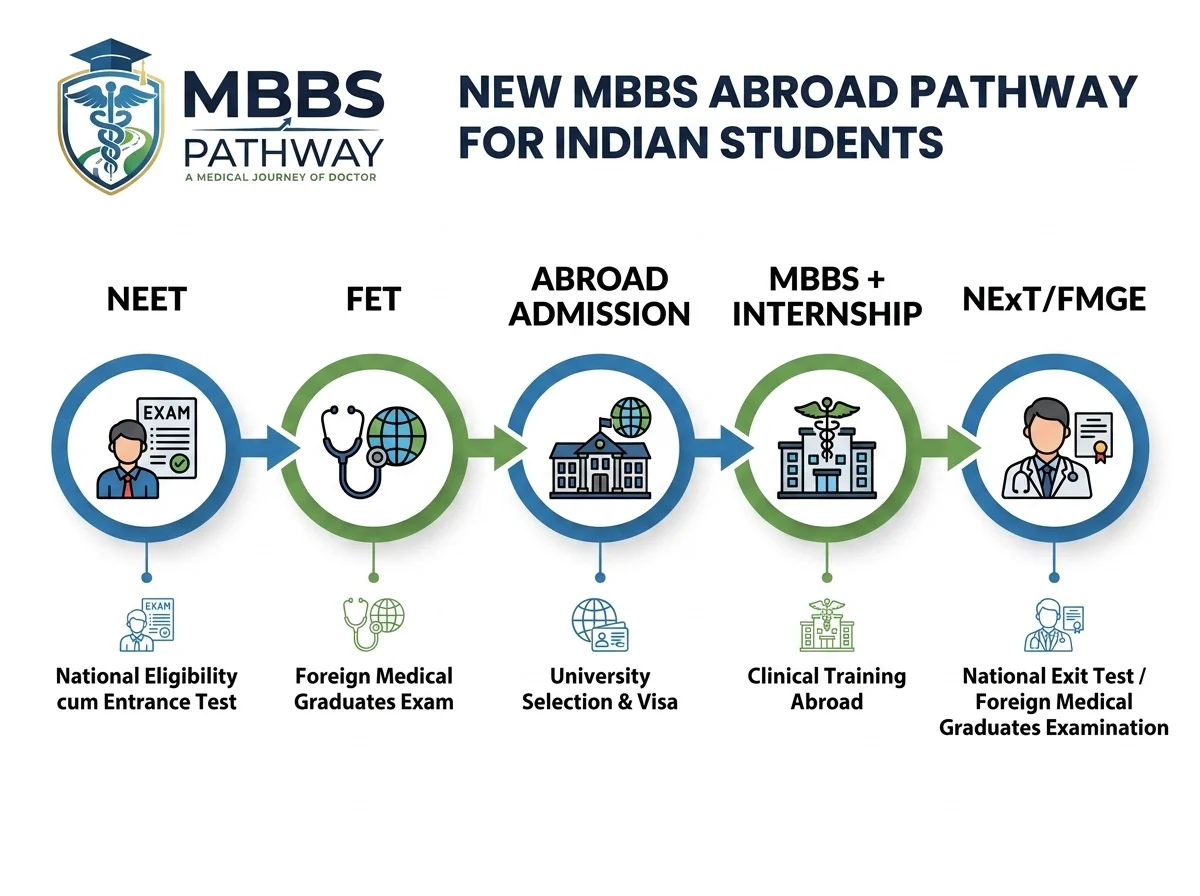
The proposed sequence under the new NMC framework would be: NEET qualification → FET → Abroad admission → MBBS + Internship → Return → FMGE or NExT.
FET is designed to be a first-year MBBS-level exam. The logic behind it is sound — if a student can't pass a first-year MBBS paper, they'll likely struggle to complete a full MBBS program abroad, fail FMGE, and become one of those statistics we all want to avoid. However, it also acts as an additional filter. Moreover, it places another exam between a student and their admission — which will require additional preparation time.
But here's the critical point: as of April 2026, FET has not been officially implemented. It exists in draft gazette form. The brochure hasn't been released. The exam dates haven't been announced. Students applying for 2026 intake do not need to appear for FET right now. That said, this can change — so keep watching the NMC website.
💡 What You Should Do Right Now
NEET score matters more than ever. Even without FET, aim for 450+ in NEET. This ensures you're eligible for reputable NMC-compliant universities in Russia, Uzbekistan, and Georgia. Furthermore, a strong NEET score suggests you're academically prepared for a foreign medical curriculum — reducing your risk of struggling with FMGE later.
How MBBS Pathway Verifies Every University We Recommend
I want to be transparent about exactly how we operate, because transparency is what separates us from the consultants you should be worried about. I've talked about how to spot fake consultants in detail elsewhere — but here's our own verification process.
At MBBS Pathway, before we recommend any university to any student, we go through a seven-point verification checklist:
- WDOMS Verification. We confirm that the university is listed in the World Directory of Medical Schools with valid recognition/accreditation in its home country.
- NMC Advisory Check. We check whether NMC has issued any specific advisory or warning against that institution. Several universities have been flagged — we don't recommend any flagged institution.
- Indian Embassy Confirmation. We either directly contact or review correspondence from the Indian Embassy in the destination country confirming the institution's compliance status.
- Curriculum Duration Audit. We review the official course structure to confirm minimum 54 months of academic training before the 12-month internship.
- English-Medium Confirmation. We obtain written confirmation from the university that all academics and examinations are conducted in English.
- FMGE Performance Review. We track which universities have the strongest FMGE outcomes for Indian graduates. We use this data — not marketing material — to make recommendations. Read our FMGE analysis here.
- Student Feedback Loop. We maintain relationships with students currently studying at every university we recommend. Their ongoing feedback shapes whether we continue recommending a specific institution.
None of this is perfect — policies change, universities change, NMC rules change. But this process means every recommendation we make is grounded in the most current information we can gather. It's also why our FMGE success rate among students we've placed is significantly higher than the national average.
📥 Download Our NMC-Verified University List 2026
We've compiled a regularly updated list of universities that currently meet NMC's FMGL Regulations in Russia, Uzbekistan, Georgia, Kazakhstan, Bangladesh, and Nepal — with FMGE pass rate data and fee comparisons. It's free, and it'll save you hours of research.
📩 Get the Free University ListNo spam. Just the list + a 15-minute call to walk you through it if you want.
Frequently Asked Questions — NMC Guidelines for MBBS Abroad 2026
The core framework is NMC's Foreign Medical Graduate Licentiate (FMGL) Regulations 2021. Key requirements: NEET qualification (mandatory, valid 3 years for abroad); minimum 54 months academic training; 12-month internship in the same country; English-medium instruction; no online-only programs; clinical exposure in all core subjects. In March 2026, NMC added a rule requiring students who studied online during COVID to complete physical onsite compensation training at the same foreign university.
Yes — but only if you meet every NMC requirement. Your university must be in the World Directory of Medical Schools, the course must be 54+ months in English, with a mandatory 12-month internship completed abroad. After returning, you must clear FMGE (or NExT once implemented). Degrees from non-compliant universities are not recognised in India, regardless of what anyone tells you.
Absolutely. NEET is mandatory for all Indian citizens and OCI holders who want to study MBBS abroad and eventually practise in India. The NEET result is valid for 3 years for abroad admissions. Any consultant claiming NEET is not required is either wrong or deliberately misleading you.
No. NExT has been deferred for 3–4 years from its originally planned 2025 implementation. FMGE remains the mandatory licensing exam for foreign graduates returning to India. NExT pilot tests may be conducted in 2026–2027, but the full national rollout is not expected before 2028–2029. Students currently in years 1–5 abroad should focus on FMGE preparation.
No. NMC's FMGL Regulations 2021 require you to complete your mandatory 12-month internship in the same country and institution where you completed your MBBS. Split internships — part abroad, part in India — are explicitly not accepted. Any consultant who says otherwise is giving you outdated advice that could destroy your career.
FET (Foreign Eligibility Test) is a proposed new pre-departure exam that Indian students would need to clear before taking admission abroad. It's based on first-year MBBS-level curriculum. As of April 2026, FET is still in draft/gazette form — no implementation date, no brochure, no exam centre list. Students applying for 2026 intake do not need to clear FET right now. However, this can change — monitor nmc.org.in regularly.
Follow these steps: (1) Verify the university on wdoms.org — World Directory of Medical Schools. (2) Check nmc.org.in for any advisories against the institution. (3) Email the university directly using their official domain email to confirm English-medium instruction and 54-month duration. (4) Contact the Indian Embassy in that country. (5) Speak with current Indian students at the university. Don't rely solely on what your consultant tells you — verify independently.
The consequences are severe and permanent. You cannot appear for FMGE or NExT. Without the licensing exam clearance, you cannot register with NMC or any State Medical Council. Without registration, you cannot legally practise medicine in India. Your degree has no legal value in the Indian medical system — regardless of how much you spent or how long you studied. Verification before admission is therefore absolutely non-negotiable.
NMC requires candidates to qualify NEET — that means reaching the qualifying percentile: 50th percentile for general category, 40th percentile for SC/ST/OBC. Most reputable universities in Russia, Uzbekistan, and Georgia accept qualifying-score students. However, aiming for 450+ is strongly advisable, particularly if the FET exam is implemented in future — it tests first-year MBBS level knowledge, which correlates with higher NEET scores.
Russia, Georgia, Kazakhstan, Uzbekistan, Bangladesh, and Nepal have strong track records of offering NMC-compliant programs. However, the specific university within a country matters more than the country itself. Two universities in the same city can have dramatically different FMGE outcomes and compliance records. Always verify at the university level, not just the country level.
On March 6, 2026, NMC issued a notice requiring students who completed any MBBS coursework online during the pandemic to complete equivalent offline physical training at the same foreign university. The notice specifies that two years cannot be compensated in one year, and the university must issue an Embassy-authenticated certificate. However, on March 18, 2026, after significant student protests, NMC adopted a more pragmatic approach — recognising that online study was not optional during COVID and softening some of the stricter requirements.
Absolutely. Since NExT has been deferred for 3–4 years, FMGE is the exam you'll appear for if you return to India before 2028–2029. More importantly, FMGE preparation — which covers all MBBS subjects in depth — also serves as solid foundation for NExT when it does arrive. Start FMGE-specific preparation from 3rd year abroad. The students who clear FMGE on the first attempt are almost always those who started preparation early.
Still Confused About NMC Rules for Your Specific Situation?
Book a free 20-minute call with Kuldeep Chetry. Tell me where you are in the process and I'll give you a straight, regulation-accurate answer — no sales pitch.
📞 Book a Free Consultation Call