Call/WhatsApp: +91 88266 53638

FMGE pass rate by country 2025 — what every Indian student must know before choosing
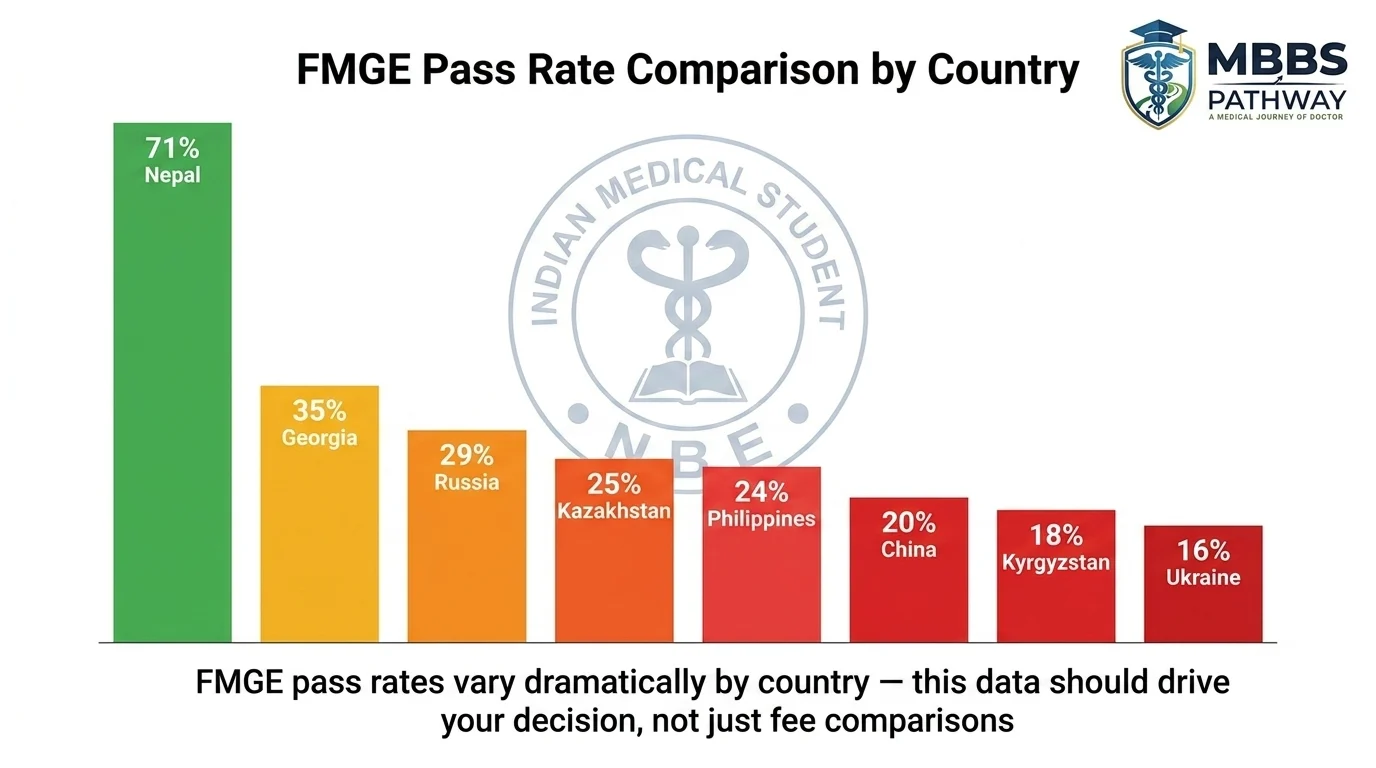
Table of Contents
- What is FMGE and Why Does It Matter More Than Your MBBS Degree?
- The Hard Truth: Only 23.9% Passed FMGE in December 2025
- FMGE Pass Rate by Country 2025: The Complete Breakdown
- Why Do Some Countries Consistently Produce Better FMGE Results?
- How to Choose the Right Country Based on FMGE Data
- Common Mistakes Students Make When Choosing MBBS Abroad
- What Happens If You Fail FMGE? (And How to Avoid It)
- FMGE Success Opens Doors — What Comes After?
- How MBBS Pathway Helps Students Clear FMGE
- Frequently Asked Questions About FMGE Pass Rates by Country
I've counseled over 1,000 Indian students who went abroad to study MBBS, and I can tell you this without hesitation: the country you choose will determine whether you pass FMGE or join the 76% who fail.
That's not an exaggeration. According to the latest NBE data, the December 2025 FMGE session had a pass rate of just 23.9%. The June 2025 session was even worse at 18.61%. Think about that — more than three out of every four students failed.
But here's what most consultants won't tell you: pass rates differ massively by country. While students from Nepal are clearing FMGE at rates as high as 71%, those from certain Chinese universities are passing at barely 9.6%. Same exam. Same difficulty. Completely different outcomes.
So why does this happen? And more importantly, how do you make sure you're not part of the 76%?
In my experience running MBBS Pathway for the past seven years, I've seen this pattern repeat: students who choose their country based on fees alone struggle with FMGE. Those who pick based on curriculum alignment and clinical training pass.
This article breaks down the actual FMGE country-wise pass percentages for 2025, explains why some countries consistently outperform others, and gives you the framework to choose wisely. Moreover, I'll share data from NBE (National Board of Examinations) that most students never see until it's too late.
What is FMGE and Why Does It Matter More Than Your MBBS Degree?
Let me be blunt: your foreign MBBS degree means nothing in India until you clear FMGE.
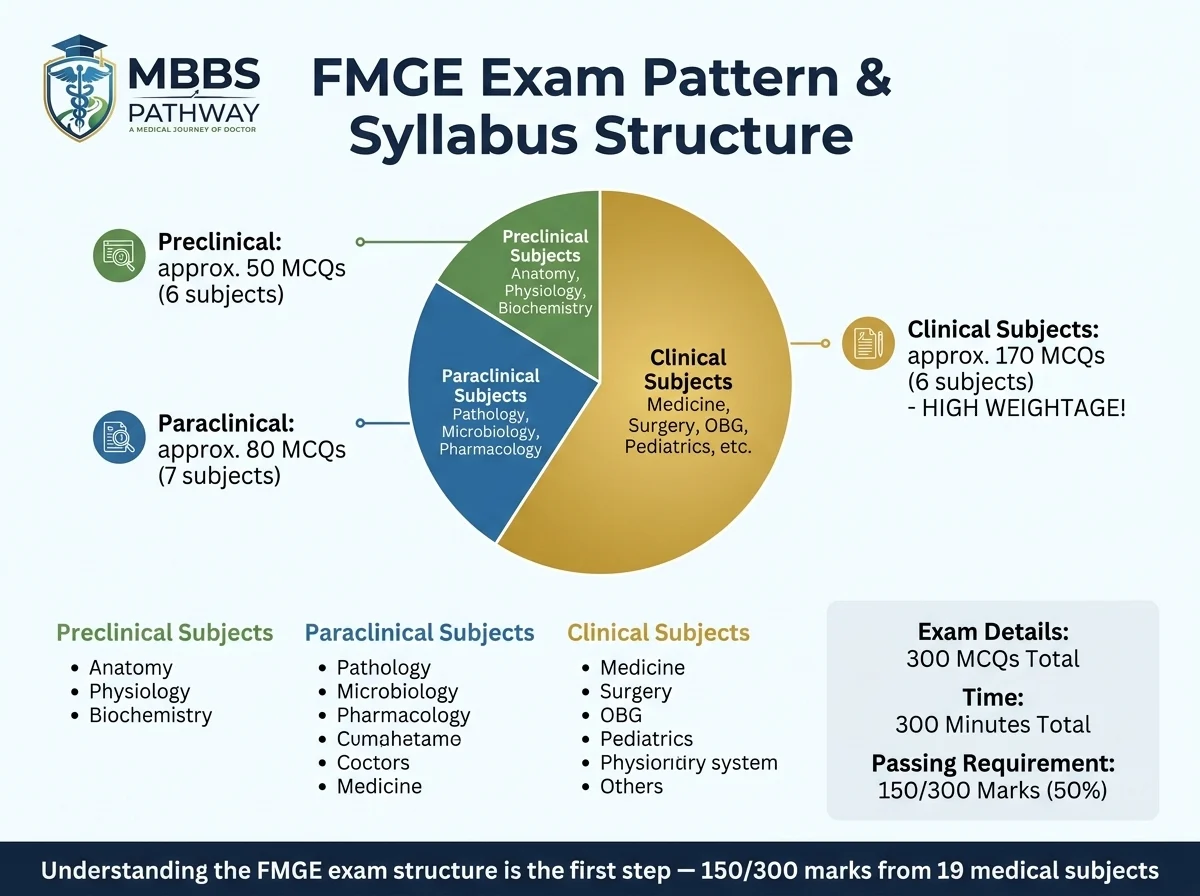
The Foreign Medical Graduate Examination is a licensing exam conducted by the National Board of Examinations in Medical Sciences (NBEMS). It's held twice every year — in June and December. You need to score at least 150 out of 300 marks to pass, which is a 50% cutoff.
Sounds simple, right? It's not.
The exam covers all 19 subjects from your MBBS curriculum. Furthermore, it tests not just theoretical knowledge but clinical application — the kind you only get through hands-on patient exposure during your studies. That's where many foreign universities fall short.
Think of FMGE as the gatekeeper. Without passing it, you can't register with the National Medical Commission (NMC) or any State Medical Council. Therefore, you can't practice medicine, can't apply for PG courses through NEET-PG, and can't even complete your compulsory internship in India.
Essentially, failing FMGE means your six years abroad and lakhs of rupees spent become a dead investment.
FMGE vs NExT: What's Changing in 2026?
You've probably heard about the National Exit Test (NExT) that's supposed to replace FMGE. Let me clarify what's actually happening because there's a lot of confusion.
NExT is planned to replace both FMGE and NEET-PG eventually. However, as of April 2026, there's no official implementation date for foreign medical graduates. The NMC has been running pilot tests, but FMGE continues to operate normally.
Here's the key difference: FMGE is theory-only with 300 MCQs. NExT will have two parts — a theory paper (Part 1) and a practical clinical skills assessment (Part 2). It's also supposed to be conducted once a year instead of twice.
Until NBEMS officially announces NExT for foreign graduates, continue preparing for FMGE. Don't fall for consultants who promise "NExT exemptions" or claim your university is "NExT-ready." Those are red flags.
The Hard Truth: Only 23.9% Passed FMGE in December 2025
Let's look at the numbers that NBE published. These aren't estimates or averages — this is official data:
- FMGE June 2025: 18.61% pass rate (6,707 passed out of 36,039 appeared)
- FMGE December 2024: 29.62% pass rate (highest in recent sessions)
- FMGE December 2025: 23.9% pass rate
Now, compare this to what happens with Indian private medical colleges. Students from reputed Indian colleges have a NEET-PG qualification rate of 60-70%. That's triple the FMGE pass rate.
Why such a massive difference? Three reasons stand out:
- Language barriers: Many foreign universities teach in English, but clinical rotations happen in the local language. Consequently, students miss out on real patient interaction.
- Curriculum mismatch: The FMGE syllabus is based on the NMC's Indian MBBS curriculum. Foreign universities don't always align their teaching with these topics.
- Lack of clinical exposure: This is the biggest issue. Some universities give you theoretical knowledge but very limited hands-on training with actual patients.
But here's where it gets interesting: not all countries perform equally poorly.
Students from Nepal clear FMGE at rates of 34% to 71%. Meanwhile, students from certain universities in China pass at rates below 10%. Same exam. Wildly different preparation levels.
This brings us to the critical question: which countries give you the best shot at clearing FMGE?
FMGE Pass Rate by Country 2025: The Complete Breakdown
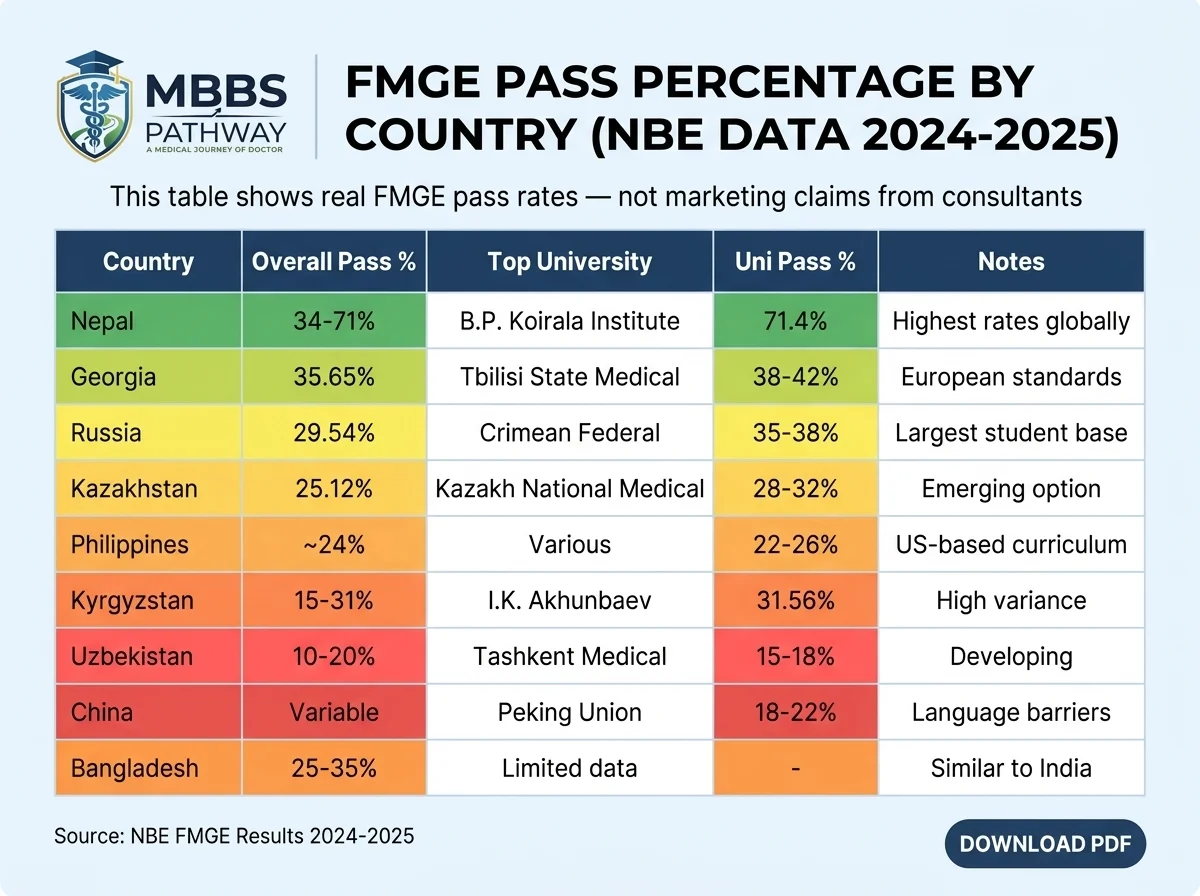
Based on the latest NBE data and analysis of multiple FMGE sessions, here's how different countries stack up. I'm listing them from highest to lowest pass rates:
1. Nepal: The Highest FMGE Pass Rate (34% to 71%)
Nepal consistently tops the FMGE performance charts. The overall pass rate ranges from 34% to over 70%, depending on which university you attend.
For instance, B.P. Koirala Institute of Health Sciences recorded a 71.4% pass rate (55 out of 77 students passed). That's nearly triple the global average.
Why does Nepal perform so well?
- The medical curriculum in Nepal is heavily based on the Indian system since both countries share similar healthcare challenges
- Clinical training happens in English with patient cases that mirror what you'll see in India
- Students get extensive hands-on exposure during their MBBS years
- Lower cost of living means more students can afford to stay focused on studies rather than working part-time
However, Nepal has limited medical university options compared to Russia or Georgia. Therefore, admission competition is higher.
Learn more about MBBS in Nepal admission process →
2. Georgia: European Standards with 35.65% FMGE Pass Rate
Georgia has emerged as a top choice for Indian students, and the FMGE results prove why. The overall pass rate is approximately 35.65%, with top universities performing even better.
Medical universities in Tbilisi and Batumi follow European medical education standards. Plus, they're recognized by the NMC, WHO, and medical councils across the world.
What I particularly like about Georgian universities is their clinical training setup. Students rotate through government hospitals with high patient volumes, giving them real diagnostic experience.
But there's a catch. Georgia's medical licensing process has changed recently, and graduates may face challenges getting medical licenses to practice in Georgia itself after graduation. This doesn't affect your ability to practice in India after clearing FMGE, but it's worth knowing.
Explore NMC-approved medical universities in Georgia →
3. Russia: 29.54% Overall, But Top Universities Excel
Russia remains the most popular MBBS abroad destination for Indian students, and for good reason. The overall FMGE pass rate is 29.54%, which is above the global average.
However — and this is crucial — pass rates vary dramatically between universities:
- Crimean Federal University: 35-38% pass rate
- Kazan Federal University: 32-36% pass rate
- RUDN University: 28-32% pass rate
- Lesser-known provincial universities: 15-20% pass rate
The difference? Quality of clinical training. Top Russian medical universities have affiliated hospitals where students get hands-on training from Year 3 onwards. Smaller universities may have limited clinical facilities.
In my experience, Russian universities that specifically prepare students for FMGE through coaching programs see significantly better results. For example, Kazan Federal has dedicated Indian student support teams that conduct FMGE prep sessions.
Read our complete guide to MBBS in Russia with fees and university comparison →
4. Kazakhstan: Emerging Destination with 25.12% Pass Rate
Kazakhstan is gaining popularity due to affordable fees and improving educational standards. The overall FMGE pass rate stands at 25.12%.
Universities like Kazakh National Medical University and Al-Farabi Kazakh National University show better performance (28-32%) compared to newer institutions.
The key advantage? Kazakhstan follows a Soviet medical education model similar to Russia, but with lower living costs and easier visa processes.
Discover MBBS opportunities in Kazakhstan →
5. Philippines: 24% Pass Rate with US-Based Curriculum
Filipino medical universities follow a US-based curriculum taught entirely in English. The FMGE pass rate hovers around 24%.
What's interesting is that despite having American-style medical education, Filipino graduates don't perform as well as Nepal or Georgia. Why?
The US medical curriculum focuses heavily on research and diagnostics, whereas FMGE tests practical clinical knowledge aligned with Indian healthcare scenarios. There's a gap between what's taught and what's tested.
Still, for students who plan to eventually take the USMLE (United States Medical Licensing Examination), Philippines can be a strategic choice.
6. Kyrgyzstan: 15% to 31% Depending on University
Kyrgyzstan presents a mixed picture. While the overall pass rate is lower (15-20%), certain universities like I.K. Akhunbaev Kyrgyz State Medical Academy have shown pass rates as high as 31.56%.
The challenge with Kyrgyzstan is quality control. There are many new medical universities that don't have established clinical training protocols. Therefore, careful university selection becomes critical.
7. Uzbekistan: 10% to 20% Pass Rate (Emerging but Risky)
Uzbekistan is one of the newest MBBS destinations for Indian students. Fees are low, and admissions are easy. But the FMGE pass rate tells a different story — typically 10-20%.
Most Uzbek universities are still developing their clinical training infrastructure. Moreover, language can be a barrier since many clinical rotations happen in Uzbek or Russian.
If you're considering Uzbekistan, make sure the university has NMC recognition and ask for verifiable FMGE pass rate data of their alumni.
Check NMC-approved universities in Uzbekistan →
8. China: Variable Results, Some Universities Below 10%
China has hundreds of medical universities, but FMGE results are highly inconsistent. While some universities show decent pass rates (18-22%), others perform poorly.
For example, Dalian Medical University had only a 9.6% pass rate (8 out of 83 students passed). That's alarmingly low.
The main issues are:
- Language barrier in clinical years (many rotations are in Mandarin)
- Different diagnostic approaches compared to Indian medical practice
- Limited exposure to clinical cases relevant to Indian healthcare
If you're set on China, stick to top-tier universities like Peking Union Medical College or Fudan University that have dedicated English-medium programs.
9. Bangladesh: Limited Data, But Similar Curriculum to India
Bangladesh follows a medical curriculum very similar to India's. Theoretically, this should lead to higher FMGE pass rates. However, official NBE data for Bangladesh is limited.
Anecdotal evidence from our counseling sessions suggests pass rates of 25-35%, but I'd advise caution until more concrete data emerges.
Why Do Some Countries Consistently Produce Better FMGE Results?
After analyzing hundreds of student cases, I've identified five factors that separate high-performing countries from low-performing ones:
1. Curriculum Alignment with NMC Syllabus
Countries like Nepal and Georgia design their MBBS programs keeping Indian medical requirements in mind. Their syllabi overlap significantly with what FMGE tests.
Contrast this with universities that follow purely European or American curricula. They might be excellent medical schools globally, but they don't specifically prepare you for FMGE.
2. English-Medium Instruction Throughout
This seems obvious, but it's often where things break down. Many universities advertise "English-medium" programs, but clinical rotations happen in the local language.
If you can't communicate with patients or understand case presentations in your clinical years, you'll struggle to develop the diagnostic skills FMGE tests.
3. Quality and Quantity of Clinical Exposure
This is the single biggest differentiator. Universities with attached teaching hospitals that handle high patient volumes give students real clinical experience.
For instance, Georgian universities mandate minimum hours of clinical rotations across different specialties. Russian universities like Kazan Federal have dedicated simulation labs for practice.
Meanwhile, some universities in China or Uzbekistan have limited hospital access, and students mainly observe rather than participate in patient care.
4. Dedicated FMGE Preparation Support
Top-performing universities have caught on to this: Indian students need specific FMGE prep.
Therefore, universities like Crimean Federal in Russia and Tbilisi State Medical University in Georgia now offer:
- FMGE coaching classes during final year
- Mock tests aligned with NBE question patterns
- Study groups led by senior Indian students who've cleared FMGE
- Access to India-specific medical case studies
This extra support makes a measurable difference in pass rates.
5. Student Community and Support System
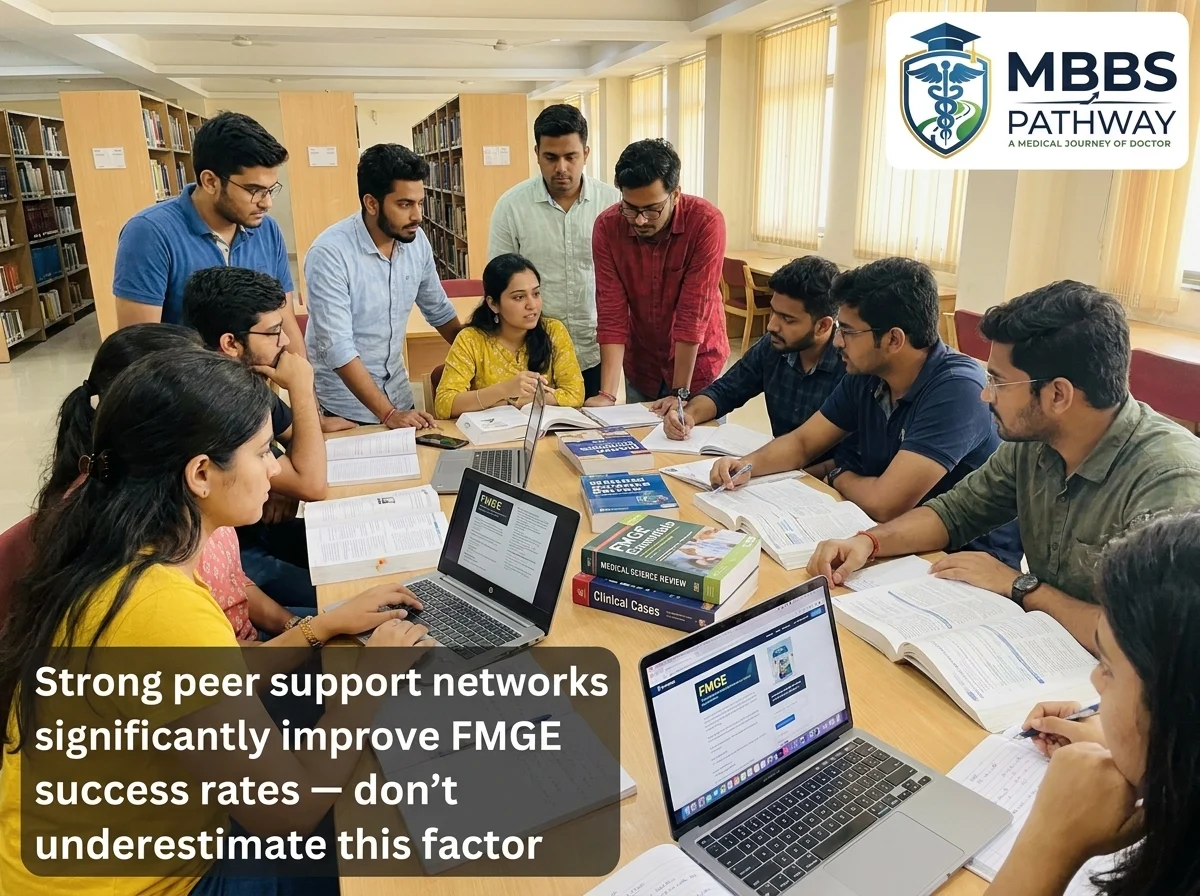
Countries with large Indian student populations tend to show better FMGE results. Why? Because students form study groups, share resources, and learn from seniors who've already cleared the exam.
Russia has the largest Indian student community (30,000+), followed by Georgia and Kazakhstan. This network effect helps students prepare better.
How to Choose the Right Country Based on FMGE Data
Looking at FMGE pass rates alone won't give you the full picture. You need to consider multiple factors together. Here's the framework I use when counseling students:
Step 1: Match Your NEET Score to Realistic Options
If you scored 250-300 in NEET, you have flexibility to choose top universities in Nepal, Georgia, or Russia.
If you scored 150-200 or didn't qualify, you'll need to consider a broader range including Kazakhstan, Philippines, or Bangladesh where admission requirements are more relaxed.
But remember: easier admission doesn't mean easier FMGE. In fact, it's often the opposite.
Step 2: Calculate Total Cost Including FMGE Prep
Don't just compare tuition fees. Factor in:
- Living expenses for 5-6 years
- FMGE coaching costs (₹1-3 lakhs)
- Multiple FMGE attempt fees if needed
- Travel costs
A university with 50% higher tuition but 2x better FMGE pass rate can actually save you money in the long run.
Read our detailed cost comparison: MBBS Abroad vs Private Medical College in India →
Step 3: Verify NMC Recognition and FMGE Track Record
This is non-negotiable. Only attend universities that are:
- Listed in the NMC's approved foreign medical institutions directory
- Included in the World Directory of Medical Schools
- Recognized by the medical council of their home country
Furthermore, ask for documented FMGE pass rates of alumni from the past 3 years. If the consultant can't provide this data, that's a red flag.
Step 4: Assess Clinical Training Infrastructure
During university shortlisting, specifically ask:
- How many attached teaching hospitals does the university have?
- What's the patient inflow per month?
- From which year do students start clinical rotations?
- How many hours of clinical practice are mandatory?
- Is there a simulation lab for practicing procedures?
Universities with strong clinical infrastructure almost always show better FMGE results.
Step 5: Consider Future Career Plans Beyond FMGE
Are you planning to practice only in India, or do you want options abroad?
If you're targeting the US or UK eventually, universities in the Philippines or Georgia (which have MCI/NMC recognition plus international accreditation) make sense.
If you're focused purely on India and want the highest FMGE success probability, Nepal or top Russian universities are your best bet.
Common Mistakes Students Make When Choosing MBBS Abroad
In seven years of counseling students, I've seen these mistakes repeatedly:
Mistake #1: Choosing Based Only on Low Fees
A university offering MBBS for ₹15 lakhs total sounds tempting. But if only 12% of their students pass FMGE, you'll end up spending 2-3 years attempting the exam, paying coaching fees, and delaying your medical career.
Instead, calculate the total cost to medical license, not just the degree cost.
Mistake #2: Ignoring Language Requirements for Clinical Years
Many students discover too late that while lectures are in English, patient interaction happens in Russian, Georgian, or Mandarin.
So they miss out on actual clinical learning during Yr 4-6, which directly impacts FMGE preparation.
Mistake #3: Not Researching University-Specific FMGE Data
Country-level pass rates are helpful, but university-specific data is what matters.
For example, Russia's overall pass rate is 29%, but this ranges from 38% at top universities to 12% at newer ones. Huge difference.
Mistake #4: Falling for "FMGE Exemption" Scams
Let me be very clear: there is no FMGE exemption for any country except USA, UK, Canada, Australia, and New Zealand.
If a consultant tells you a university in Russia, Georgia, or anywhere else offers "FMGE exemption," they're lying. Walk away immediately.
Learn how to spot fake MBBS consultants and red flags →
Mistake #5: Not Planning for FMGE Coaching
I'll be honest with you: just completing your MBBS abroad isn't enough. You'll need structured FMGE preparation.
Students who enroll in coaching programs (either during final year abroad or after returning to India) have significantly higher pass rates.
At MBBS Pathway, we provide FMGE coaching support as part of our student services. This isn't about extra fees — it's about ensuring the ₹25-40 lakhs your family invested actually leads to a medical career.
What Happens If You Fail FMGE? (And How to Avoid It)
Let's talk about the elephant in the room. With 76% of students failing, there's a very real possibility you might not clear FMGE on your first attempt.
So what happens then?
The good news: There's no limit on attempts. You can appear for FMGE as many times as needed — the exam is held twice a year, so you can reattempt in six months.
The not-so-good news: Each attempt costs time and money. You'll need to:
- Pay the exam fee again (₹6,195 currently)
- Continue FMGE coaching for another 6 months
- Delay your internship and medical practice
- Deal with the psychological stress of repeated attempts
Most students who score between 130-145 marks (just below the 150 passing mark) clear on their second attempt with focused preparation.
However, students scoring below 120 typically need to invest in intensive coaching and may require 2-3 attempts.
How to Maximize Your Chances of First-Attempt Success
Based on data from our 1,000+ placed students, here's what actually works:
- Choose your university strategically: Pick a university with proven FMGE track record (>25% pass rate minimum)
- Focus on clinical subjects from Year 3 onwards: Medicine, Surgery, Pediatrics, OBG carry maximum FMGE weight
- Join a study group with seniors who cleared FMGE: Learn from their strategies and mistakes
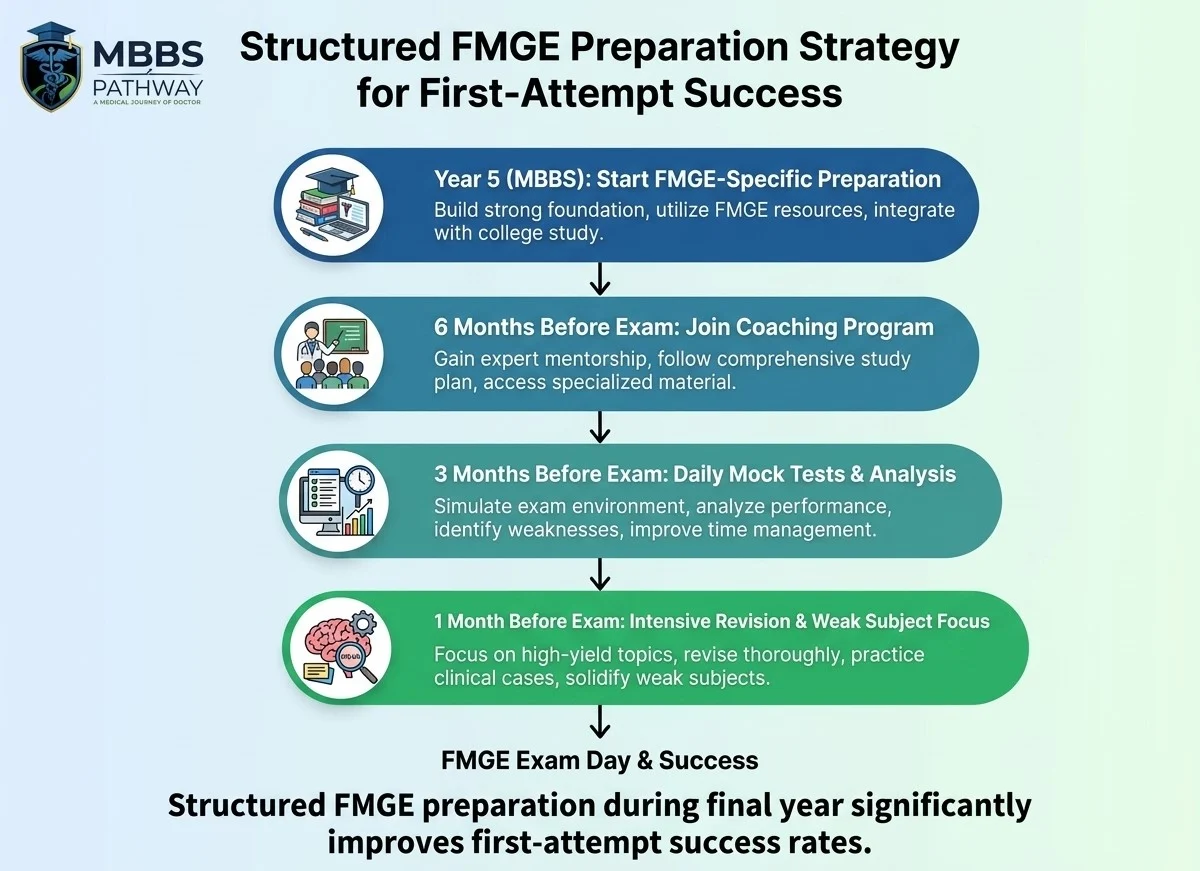
- Start FMGE-specific preparation in Year 5: Don't wait until after graduation
- Take at least 10 full-length mock tests: NBE-pattern practice makes a huge difference
- Focus on weak subjects identified through mock tests: 6-7 marks improvement in your weakest subjects can push you past 150
Additionally, many successful students recommend solving past 5 years' FMGE question papers repeatedly. The exam pattern doesn't change dramatically year to year.
FMGE Success Opens Doors — What Comes After?
Once you pass FMGE, here's the typical career pathway:
Immediate Next Steps
- Download your FMGE certificate: Available on the NBE portal within a week of result declaration
- Apply for provisional registration: Register with your State Medical Council or the NMC
- Complete internship (if not done): If your MBBS abroad didn't include an internship, you must complete one year in India
Career Options Post-FMGE
Once registered, you can:
- Start medical practice: Join hospitals, clinics, or start your own practice
- Appear for NEET-PG: Pursue MD/MS specialization in India
- Join government medical services: UPSC, state PSC medical officer positions
- Work in corporate hospitals: Apollo, Fortis, Max Healthcare hire FMGE-qualified doctors
The average starting salary for FMGE-cleared doctors in India ranges from ₹4-8 lakhs per annum, depending on location and specialization.
However, clearing NEET-PG for postgraduate specialization (MD/MS) significantly boosts earning potential to ₹12-25 lakhs per annum post-specialization.
How MBBS Pathway Helps Students Clear FMGE
Look, I know you're reading this article because you want to make an informed decision about studying MBBS abroad. That's exactly why I started MBBS Pathway seven years ago.
We've helped 1,000+ students not just get MBBS admissions but actually clear FMGE and start their medical careers. That's our real metric of success.
Here's how we do things differently:
1. We Only Recommend Universities with Proven FMGE Records
We maintain a database of FMGE pass rates for every university we partner with. If a university's pass rate drops below 22%, we stop sending students there — even if we have a commission arrangement with them.
Why? Because our reputation depends on your success, not just your admission.
2. Free FMGE Coaching for All Our Students
Once you enroll through us, you get access to:
- Live online FMGE coaching classes starting from Year 5
- 10+ full-length mock tests with detailed analysis
- Subject-wise video lectures covering the entire FMGE syllabus
- Mentorship from doctors who've cleared FMGE
This isn't an upsell — it's included because we understand that getting you admitted is only half the job. Getting you licensed is what matters.
3. Complete Transparency on Costs and Challenges
We don't hide information about visa rejections, climate challenges, language barriers, or FMGE difficulty.
In fact, during counseling, we specifically ask students to talk to our alumni studying in their chosen country. Get the unfiltered truth before you commit.
4. End-to-End Support from Admission to FMGE
Our support doesn't end when you land in Russia or Georgia. We stay connected throughout your 6-year MBBS journey:
- Regular check-ins with students and parents
- Help with visa extensions and document attestation
- FMGE application assistance and exam center selection
- Post-FMGE career counseling
Think of us as long-term partners in your medical education journey, not just admission agents.
Frequently Asked Questions About FMGE Pass Rates by Country
Nepal has the highest FMGE pass rate, ranging from 34% to 71% depending on the university. B.P. Koirala Institute in Nepal has recorded a 71.4% pass rate, making it one of the top-performing institutions for Indian students preparing for FMGE.
Russia's overall FMGE pass rate is approximately 29.54% for 2024-2025. However, select universities like Crimean Federal University and Kazan Federal University show higher pass rates, ranging from 32% to 38%, making university selection crucial.
While the National Exit Test (NExT) is planned to eventually replace FMGE, there is no official implementation date as of April 2026. FMGE continues to be conducted normally in June and December sessions. Students should prepare for FMGE until an official announcement is made by NBEMS.
The FMGE June 2025 pass rate was 18.61%, while the December 2024 session recorded 29.62%. The December 2025 session showed a pass rate of 23.9%. Overall, approximately 76-81% of foreign medical graduates fail the FMGE exam on their first attempt.
Georgia's medical universities follow European medical education standards with English-medium instruction and strong clinical exposure. The curriculum alignment with FMGE syllabus and extensive practical training contribute to Georgia's 35.65% overall pass rate, which is significantly higher than the global average.
Chinese medical universities generally show lower FMGE pass rates, with some institutions like Dalian Medical University recording only 9.6% pass rate. The language barrier in clinical years and curriculum differences contribute to these lower success rates compared to countries like Nepal or Georgia.
There is no limit on the number of FMGE attempts. Candidates can appear for the exam as many times as needed until they pass, provided they continue to meet the eligibility criteria. The exam is conducted twice a year in June and December, giving students multiple opportunities.
Candidates must score at least 150 marks out of 300 to pass FMGE, which is a 50% passing score. The exam consists of 300 multiple-choice questions divided into two papers, with no negative marking for incorrect answers.
After passing FMGE, you receive provisional or permanent registration with the NMC or State Medical Council. If your MBBS abroad did not include a compulsory internship, you must complete a one-year internship in India before you can practice medicine independently or write prescriptions.
Nepal has a higher overall FMGE pass rate (34-71%) compared to Russia (29.54%). However, top Russian universities like Kazan Federal and Crimean Federal show competitive pass rates of 32-38%. The choice depends on individual university quality, fee structure, clinical training opportunities, and your NEET score.
Yes, extensive clinical exposure significantly improves FMGE performance. Universities that provide hands-on patient interaction, clinical rotations across specialties, and practical training prepare students much better for both theoretical questions and real-world medical scenarios tested in FMGE.
Uzbekistan's FMGE pass rate typically ranges from 10% to 20%, which is below the global average of 24%. Students from Uzbekistan generally need strong self-study habits and additional FMGE preparation coaching to improve their chances of passing on the first attempt.
No, students who complete MBBS in Bangladesh must pass FMGE to practice in India. Only graduates from five countries are exempt from the FMGE requirement: USA, UK, Canada, Australia, and New Zealand. All other foreign medical graduates, including those from Bangladesh, must clear FMGE.
FMGE is only for foreign medical graduates and consists of 300 theory-based MCQs. NExT will be for all medical graduates (both Indian and foreign), conducted once a year, and will include both theoretical assessment (Part 1) and practical clinical skills evaluation (Part 2). NExT will also serve as the entrance exam for PG medical courses, replacing NEET-PG.
Clinical subjects carry maximum weightage in FMGE. Medicine, Surgery, Obstetrics & Gynecology, and Pediatrics together account for approximately 40-45% of the total questions. Therefore, strong preparation in these subjects is critical for crossing the 150-mark threshold.
Final Thoughts: Choose Wisely, Prepare Thoroughly
Here's what seven years of counseling students has taught me: the country you choose matters more than you think, but it's not the only factor.
Yes, Nepal has a 71% FMGE pass rate. But if you can't get admission there, does that mean you should give up on MBBS abroad? Absolutely not.
Students from Russia, Georgia, and Kazakhstan also clear FMGE in good numbers — if they choose the right university and prepare strategically.
The key takeaways from this analysis:
- Don't choose a university based on fees alone. Calculate total cost-to-license, not just degree cost.
- Verify university-specific FMGE data, not just country averages. Two universities in the same country can have wildly different results.
- Prioritize universities with strong clinical training infrastructure and dedicated FMGE preparation support.
- Start FMGE preparation from Year 5, not after graduation. Students who do this have 2-3x higher first-attempt pass rates.
- Don't believe consultants who promise "FMGE exemptions" or guaranteed results. If it sounds too good to be true, it is.
At MBBS Pathway, our goal isn't just to get you a medical degree — it's to help you become a licensed, practicing doctor in India. That's why we obsess over FMGE pass rates, university quality, and student support systems.
If you're serious about studying MBBS abroad and clearing FMGE, I'd love to have a conversation with you. We'll look at your NEET score, budget, career goals, and find the best-fit university that gives you the highest probability of success.
Book a free counseling session below. Let's make sure your MBBS investment leads to a medical career, not just a certificate.
Schedule Free MBBS Abroad Counseling →Important Official Resources
For the most up-to-date and official information regarding foreign medical education guidelines, please refer to these authoritative sources: