Call/WhatsApp: +91 88266 53638

FMGE Pass Rate of Russian Medical Universities 2026: The University-Wise Data
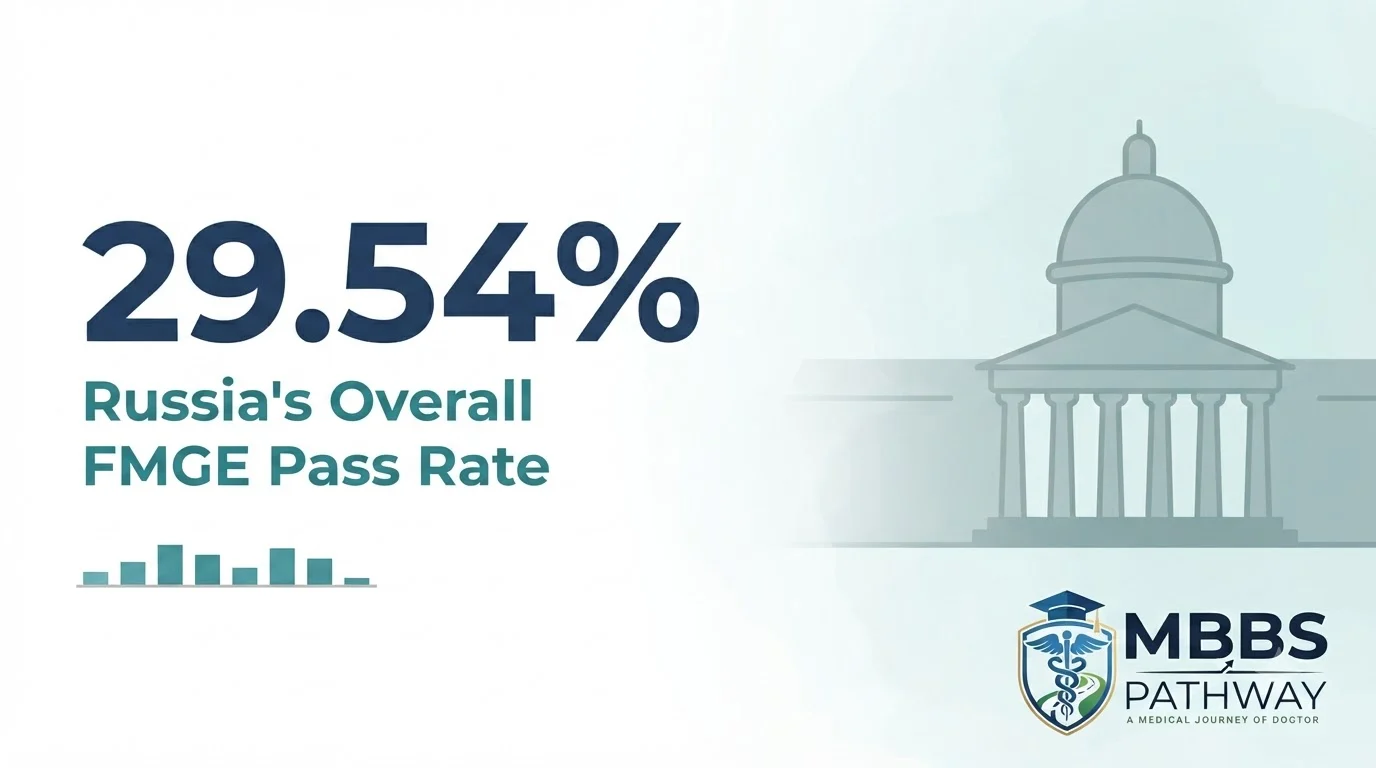
Russia's overall FMGE pass rate sits at 29.54%, going by the most recent full-year NBEMS data. That's better than the all-country average. But here's the number that actually matters: within Russia, individual universities range from under 20% to over 43%. So if you're picking a university based on the country average alone, you're working with the wrong number.
We put this guide together because we kept getting the same question from parents on our counselling calls: "Which Russian university actually has a good FMGE record?" Most consultants either dodge the question or quote a figure they can't back up. We'd rather show you the real, sourced numbers and let you judge for yourself.
Table of Contents
- The June 2026 FMGE Result Changes the Conversation
- Why the National Average Barely Tells You Anything
- The Real FMGE Numbers for Russia, University by University
- Kazan Federal or Kazan State Medical? Don't Mix Them Up
- Why Do Some Universities Do So Much Better Than Others?
- How We Use This Data When We Counsel a Family
- A Straight Answer on Cost vs FMGE Performance
- Frequently Asked Questions
The June 2026 FMGE Result Changes the Conversation
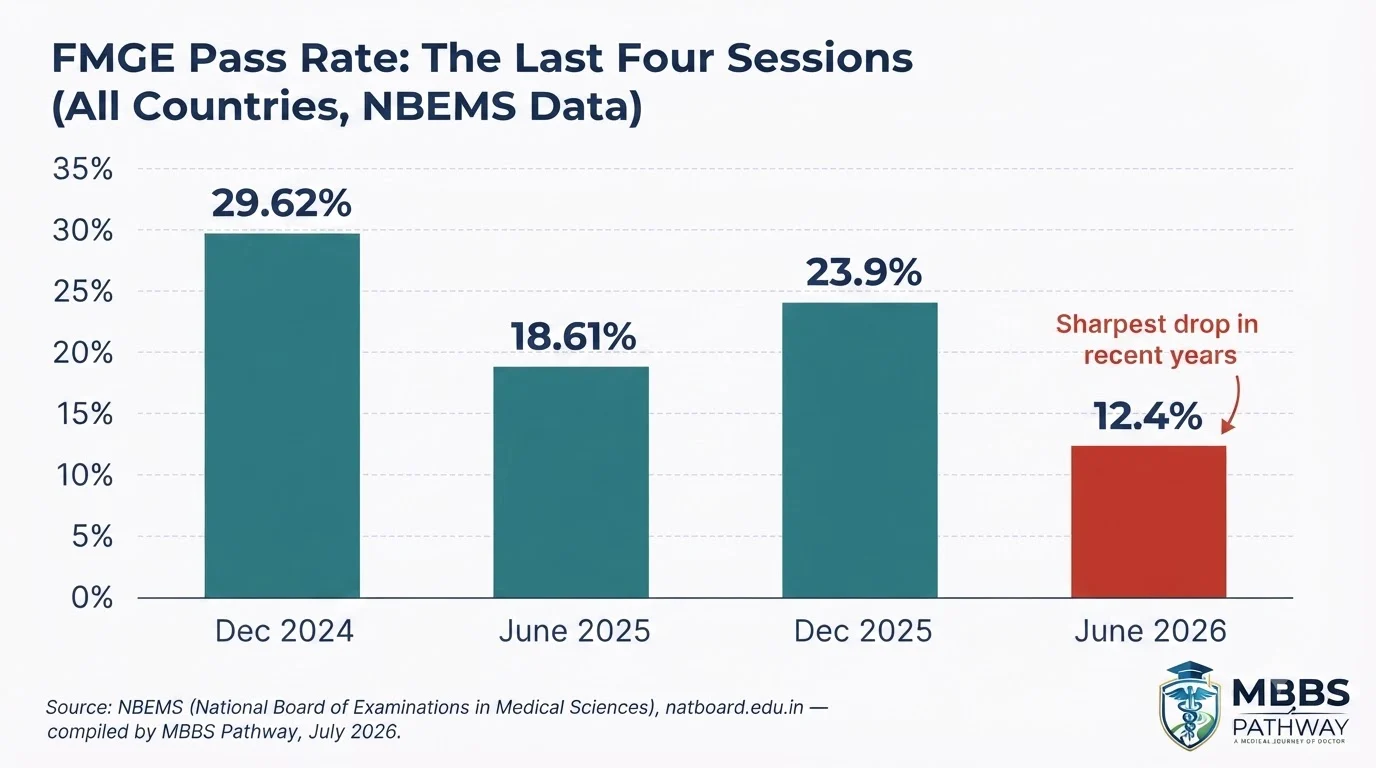
Something happened three weeks ago that most MBBS-abroad blogs haven't caught up to yet. NBEMS declared the FMGE June 2026 result on 7 July, and the pass rate fell to just 12.4%. Out of 37,448 candidates who sat the exam on 28 June, only 5,086 made it through.
That's roughly half of December 2025's pass rate, which stood at 23.9%. And it's one of the toughest sessions in recent memory. Look at the last four sessions side by side, and the trend gets hard to ignore:
- December 2024: 29.62%
- June 2025: 18.61%
- December 2025: 23.9%
- June 2026: 12.4%
So, why does this matter for someone choosing a Russian university today? Because it tells you the exam itself is getting harder, or at least less forgiving, across the board. That makes the university you pick matter more, not less. A university with strong clinical exposure and real FMGE support gives you a fighting chance even in a tough session. A university that just teaches to a textbook doesn't.
One thing worth being upfront about: this 12.4% figure is the national number, across every country, not Russia specifically. We'll get to Russia's own numbers next, and we'll explain exactly why we can't give you a matching "June 2026" figure for Russia alone just yet.
Why the National Average Barely Tells You Anything
Here's something almost nobody explains clearly, and it's the reason you'll see wildly different FMGE numbers for Russia depending on which website you're reading.
NBEMS releases the overall pass rate after every single session, in June and again in December. But country-wise and university-wise breakdowns work differently. Those get compiled once a year, after both sessions are done, and even then, it often takes several months before NBEMS or a source like Careers360 publishes the full country-by-country table. As of today, the newest Russia-specific, university-specific data still comes from 2024 — the 2025 breakdown, combining June and December sessions, hasn't been widely published yet.
That's exactly why one site tells you "Russia's pass rate is 15-40%," another says "25-30%," and a third throws out "above 80%" for a specific university with no source at all. Most of them are mixing session-level national numbers with country-level annual numbers, or just repeating a figure nobody checked. We found one site that openly admits its per-university numbers come from "testimonials and alumni feedback," not official data. That's not a criticism of the university — it's a warning about the data.
There's a second problem hiding in plain sight: sample size. A university where 15 students appeared and 10 passed will show a flashy 66% pass rate. A university where 500 students appeared and 150 passed shows 30%. Which number would you actually trust more? We'd trust the second one, and so should you. A big group gives you a real picture. A tiny group gives you a headline.
The Real FMGE Numbers for Russia, University by University
Below is the most recent full-year data available, sourced to NBEMS via Careers360's published tables, and limited to universities where at least 100 candidates appeared. We've left out the tiny-sample universities on purpose — not because their numbers are wrong, but because a percentage built on 15 or 20 students isn't something you can plan a six-year decision around.
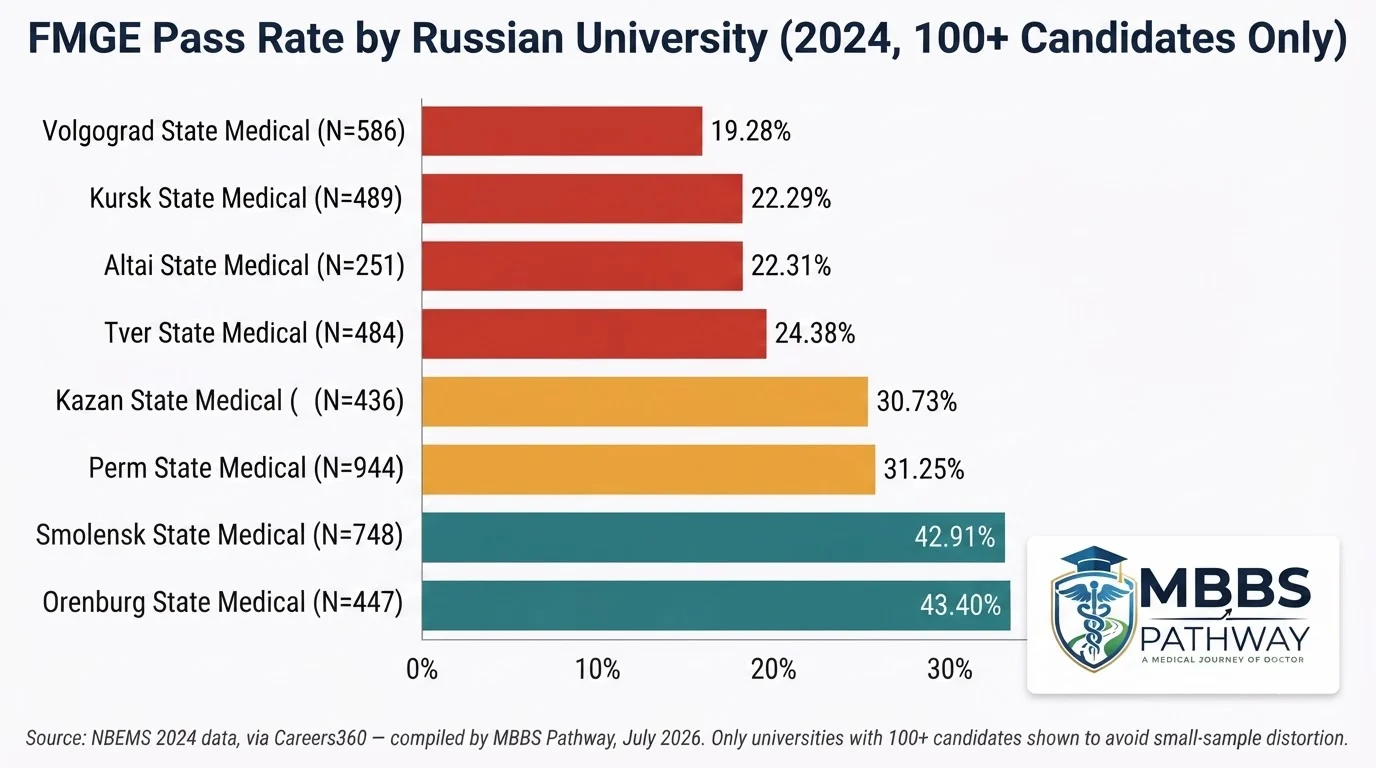
| University | Candidates Appeared | Passed | Pass Rate |
|---|---|---|---|
| Orenburg State Medical University | 447 | 194 | 43.40% |
| Smolensk State Medical University | 748 | 321 | 42.91% |
| Perm State Medical University | 944 | 295 | 31.25% |
| Kazan State Medical University | 436 | 134 | 30.73% |
| Tver State Medical University | 484 | 118 | 24.38% |
| Altai State Medical University | 251 | 56 | 22.31% |
| Kursk State Medical University | 489 | 109 | 22.29% |
| Volgograd State Medical University | 586 | 113 | 19.28% |
A few things jump out here. First, the spread is huge — more than 24 percentage points between the strongest and weakest university on this list, and these are all real, NMC-recognised, WDOMS-listed institutions. Second, notice that Kazan State Medical, often talked about as one of the "safe" popular choices, sits in the middle of the pack, not at the top. That's not a knock on Kazan. It's just a reminder that popularity and FMGE performance aren't the same thing.
We didn't build this table to tell you which university to pick. We built it so you're not choosing blind.
Kazan Federal or Kazan State Medical? Don't Mix Them Up
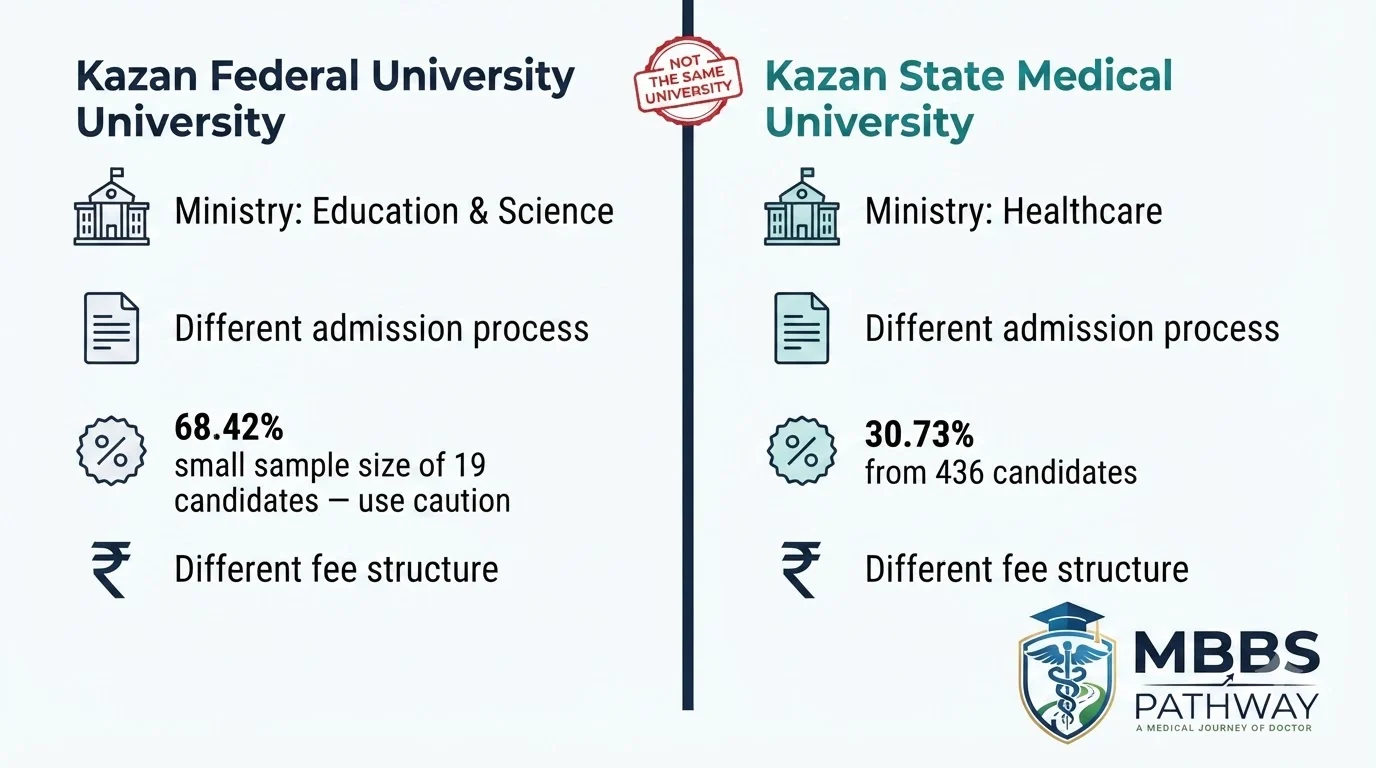
This one trips up almost everyone, including some consultants who should know better. Kazan Federal University and Kazan State Medical University are two completely different institutions, sitting in the same city, with different admission processes, different fee structures, and different FMGE records.
We've seen brochures and even other blogs quote a small-sample Kazan Federal figure while talking about "Kazan" in general, as if the two names were interchangeable. They're not. Before you sign anything, ask your consultant to spell out the university's full, official name — not just "Kazan" — and confirm which of the two you're actually being offered. It takes thirty seconds and it can save you a very expensive misunderstanding.
Why Do Some Universities Do So Much Better Than Others?
It's rarely just one thing. In our experience, four factors show up again and again:
Teaching-hospital access matters more than almost anything else. Universities with strong, established hospital tie-ups give students real patient exposure from year 3 or 4 onward. Universities without that connection lean harder on textbooks, and it shows up later at the FMGE exam hall.
Faculty stability plays a bigger role than people expect too. A university that's been teaching international students for decades, with the same core faculty, tends to have ironed out the rough edges. Newer programs are still finding their feet, and that shows in the numbers.
Then there's cohort size, and this connects back to what we said earlier. Smaller programs post more volatile results, year to year, simply because a handful of students can swing the percentage wildly. Bigger, established programs give you a steadier, more trustworthy trend line.
And, finally, FMGE-specific prep culture makes a real difference. Some universities weave FMGE-style thinking into their teaching from an early year. Others treat it as the student's own problem to solve after graduation. Ask about this directly — it's one of the most useful questions you can put to any university's admissions office.
How We Use This Data When We Counsel a Family
We'll be honest about our process, because we think you deserve to know exactly what you're getting.
First, we check the university's current NMC approval and WDOMS listing ourselves — not from an old PDF sitting in someone's inbox, but the live status. Next, we pull whatever FMGE data actually exists for that university, and we tell you plainly when a number is too small a sample to trust. Then we ask the university directly about their English-medium clinical support and FMGE-prep culture, and we share what they tell us, word for word, so you can judge it yourself.
We started doing it this way after one too many calls with a family who'd been quoted a number that simply didn't hold up when we checked it. We'd rather lose a booking than send a student somewhere on the strength of a number we can't stand behind.

A Straight Answer on Cost vs FMGE Performance
Here's the blunt version, and we say this to every family who asks: a university that's five lakh cheaper but has a 12% FMGE pass rate can end up costing you more in the long run. Coaching fees after a failed attempt, a repeat exam fee, and a year or two of delay before you can practise — all of that adds up fast, and it adds up in a way the original brochure never mentioned.
That doesn't mean the cheapest option is always the wrong one. But it does mean the fee structure shouldn't be the only number you're looking at. Read it alongside the FMGE data, and read the FMGE data alongside the sample size behind it. Do that, and you're already ahead of most families making this decision.
Frequently Asked Questions
Russia's overall FMGE pass rate for 2024, the most recent year with a full country-wise breakdown, was 29.54%. That's based on 11,276 candidates who appeared and 3,331 who passed, per NBEMS data. But this number hides a lot. Individual universities range from under 20% to over 43%, so the country average alone won't help you pick a university.
Among universities with a meaningful number of candidates, at least 100, Orenburg State Medical (43.40%, from 447 candidates) and Smolensk State Medical (42.91%, from 748 candidates) posted the strongest results in the latest available data. Be careful with any claim about a smaller university scoring 60% or 80% — check how many students that percentage is actually based on before you trust it.
Mostly it comes down to teaching-hospital access, faculty stability, cohort size, and whether the university builds FMGE-style thinking into its teaching early on. A university with strong clinical exposure and an established track record tends to post steadier, better results than a newer program still finding its footing.
No, and this mix-up happens all the time. They're two separate institutions in the same city, with different fee structures and different FMGE records. Always get the exact, full name of the university in writing before you pay anything.
Just 12.4%. Only 5,086 out of 37,448 candidates passed, according to NBEMS. That's a sharp drop from December 2025's 23.9%, and it's one of the toughest sessions in recent years. Keep in mind this is the all-country figure, not a Russia-specific one.
NBEMS only compiles country-wise and university-wise data once a year, after both the June and December sessions of that year are complete. Even then, it can take several months to actually publish. So right now, the newest Russia-specific, university-specific numbers we can point to are still from 2024.
Not necessarily, and we'd stop you from reading it that way. A low average often mixes together students who barely showed up to class with students who prepared seriously from day one. What you should actually check is the university's teaching-hospital access and FMGE-prep support, not just the headline percentage.
Somewhere between 9,000 and 12,000, based on industry estimates, since Russia sends more Indian MBBS students than any other country.
Not as of mid-2026. FMGE is still the exam in effect right now, and there's no confirmed date for NExT to fully take over. If you see a claim online about "NExT starting in 2028," treat it with caution until NMC actually confirms it.
Ask directly for the actual number of candidates who appeared and passed in the last two sessions, not just a percentage someone quotes you. Check the university's current NMC and WDOMS status yourself rather than taking anyone's word for it. And ask exactly what FMGE-specific support the university offers, beyond "we teach in English."
Not always, but it's worth checking rather than assuming either way. A university that's five lakh cheaper with a 12% pass rate can end up costing more overall once you factor in coaching fees, a repeat attempt, and a year or two of lost time.
Ask exactly which session and year their number comes from, how many candidates it's based on, and whether they can actually show you the source. If they can't answer any of that clearly, that tells you something important on its own.
Thinking about a Russian medical university?
Want the FMGE data checked for the specific ones on your list? We'll go through it with you, university by university.
Get a Free Consultation