Call/WhatsApp: +91 88266 53638
MBBS Abroad After NEET Low Score 2026 — Which Countries Accept You & What Are Your Real Options
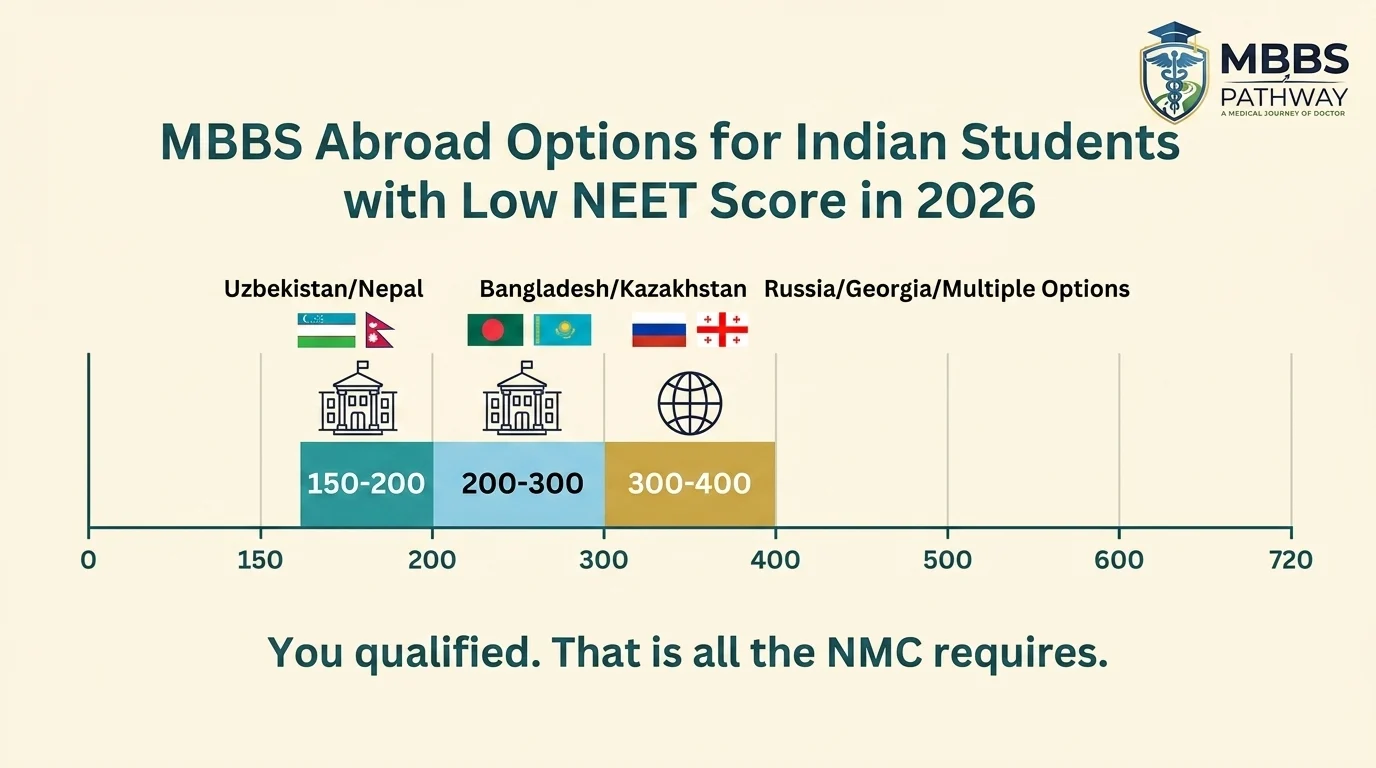
Overview: NMC only requires a qualifying NEET score — not a high rank — for MBBS abroad. Countries like Uzbekistan, Nepal, and Bangladesh accept all qualifying Indian students into NMC-approved universities.
You gave NEET everything you had. And you qualified. That's the part everyone tends to forget — you cleared the exam. The NMC doesn't care about your rank when it comes to studying MBBS abroad. It only asks one question: did you qualify?
If the answer is yes, your dream of becoming a doctor is very much alive.
In our experience counselling hundreds of students here at MBBS Pathway, we've found that the biggest fear isn't the NEET score itself. It's not knowing what happens next. So let's break it all down — honestly, clearly, and without the usual consultant fluff.
What Is the Minimum NEET Score for MBBS Abroad? (NMC 2026 Official Rule)
Here's the rule as it stands in 2026. The National Medical Commission (NMC) requires Indian students to qualify NEET — nothing more — to be eligible for MBBS at a foreign university. There is no minimum rank requirement for studying abroad.
The official NEET qualifying percentiles are:
| Category | Required Percentile | Approx. Marks (2025 data) |
|---|---|---|
| General / EWS | 50th percentile | ~137–144 marks |
| OBC / SC / ST | 40th percentile | ~113–136 marks |
| General – PwD | 45th percentile | ~127–143 marks |
So if you've crossed the qualifying mark for your category, you're eligible. Full stop.
Additionally, NMC rules for 2026 require:
- Minimum 50% in Physics, Chemistry, and Biology in Class 12 (40% for SC/ST/OBC)
- Age at least 17 years by December 31 of the admission year
- A valid NEET scorecard
We always tell students this: qualifying NEET is step one — and you've already done it. Now it's just about picking the right country and the right university. For a detailed breakdown of NMC's updated regulations, see our NMC Guidelines 2026 page.
Best Countries for MBBS Abroad with Low NEET Score
Not every country suits every student. Budget, comfort, culture, food — it all matters. Here are the four strongest options we recommend for students with scores between 140 and 400.

Data comparison infographic — Uzbekistan, Bangladesh, Nepal, Kazakhstan with fees and NMC status
Uzbekistan — Best Value for Low Scorers (₹15–22 Lakhs Total)
Uzbekistan is our top pick for students with scores in the 140–350 range. Here's why.
Universities like Samarkand State Medical University and Tashkent Medical Academy are both NMC-approved and English-medium. Total six-year fees — including tuition, hostel, and food — typically land between ₹15 and ₹22 lakhs. That's not per year. That's total.
Also, the Indian student community there is growing fast. You'll find Indian mess halls, familiar food, and a welcoming atmosphere. Safety for girls is good — most universities run secure, separate hostels with 24/7 security.
FMGE and NExT coaching systems specifically tailored for Uzbekistan-returned students are also well-established in India now. So your path back doesn't have to be difficult.
Read the complete MBBS in Uzbekistan fees and admission details on our country page.
Bangladesh — SAARC Quota Advantage for Indian Students
Bangladesh is an underrated option. Because of the SAARC quota arrangement, Indian students often get access to lower fees — total course cost typically sits between ₹20 and ₹28 lakhs.
All the top Bangladeshi medical colleges on the NMC list teach in English. The cultural similarity is a big plus — the food, the festivals, even the language proximity makes the transition easier. And since Bangladesh shares a border with India, parents can actually come visit without a 10-hour flight.
FMGE pass rates for Bangladesh-returned students have also been improving year on year, which is a strong signal. Check out the full MBBS in Bangladesh SAARC quota details for the latest university list.
Nepal — Closest Option, Hindi-Speaking Environment
Nepal is probably the most comfortable transition for most Indian students. It's practically next door. Hindi works fine there. And the cultural overlap is significant.
NMC-listed universities in Nepal are mostly English-medium for the medical curriculum. Total fees vary, but you're looking at ₹22–32 lakhs for the full course. The proximity to India also means you can be home in a day if needed — which matters a lot for families.
We've found that students who struggle with the idea of being far from home often thrive in Nepal. It removes a big emotional barrier. Explore MBBS in Nepal for Indian students for details.
Kazakhstan — Low Fees, English Medium, Growing Indian Community
Kazakhstan is another solid pick, especially for students in the 200–350 score range. Cities like Almaty and Astana (Nur-Sultan) have good medical universities with NMC recognition.
Total fees typically run ₹18–28 lakhs. The weather is cold — similar to Russia — so you'll need to prep for that. But the Indian student community is growing, and the universities are increasingly familiar with Indian students' needs.
For Kazakhstan and Kyrgyzstan options, see our combined country hub page.
Score-Wise Country Recommendation Table (150–400 NEET Marks)
This is the one table no competitor has put together. We built it based on years of actual student placements — not just theory.

Three-tier graphic showing NEET score ranges and corresponding country recommendations
| NEET Score Range | Recommended Countries | Approx. Total 6-Year Fees (₹) | Key Advantage |
|---|---|---|---|
| 140–200 marks | Nepal, Bangladesh, Uzbekistan | ₹15–28 lakhs | Qualifying score accepted, minimal extra filters |
| 200–300 marks | Uzbekistan, Kazakhstan, Bangladesh | ₹17–30 lakhs | More university choice, stronger FMGE ecosystem |
| 300–400 marks | Russia, Georgia (private), Uzbekistan, Kazakhstan | ₹20–35 lakhs | Wider options including European destinations |
Note: Georgia's state universities suspended new foreign admissions from 2026. Private Georgian universities with NMC approval remain open. Always confirm NMC recognition before applying anywhere.
If your score lands in the 300–400 range, Russia is also a strong option. Some Russian universities accept qualifying NEET scores directly. We'd recommend booking a free counselling session to get a university match based on your full profile — not just the score.
Is a Low NEET Score a Disadvantage in Your Medical Career?
Short answer: No. And we're not just saying that to make you feel better.
Your NEET score got you into medical school. But it plays zero role in your career in India from here. What actually determines your future as a practising doctor is the NExT exam — the National Exit Test — which has replaced the old FMGE system. Every MBBS graduate, whether from AIIMS Delhi or a university in Tashkent, will sit the same NExT exam to get registered in India.
So the playing field levels out completely. A student who scored 180 in NEET but studied hard for six years in Uzbekistan will face the same NExT paper as someone who scored 650 and studied at a top Indian private college.
Moreover, we've found that students who went through the more challenging journey — qualifying NEET on the lower end, studying abroad, adapting to a new country — often come back with a mental toughness that serves them well in clinical practice.
The numbers back this up. Graduates from Uzbekistan and Bangladesh are clearing NExT at competitive rates, according to trends from the earlier FMGE data that forms the basis of NExT benchmarking.
How to Strengthen Your Application With an Average NEET Score
A qualifying NEET score gets you through the eligibility door. But the right moves from here significantly improve your university placement.
Your Class 12 marks matter more than you think. Universities look at your PCB percentage in 12th grade. A strong 12th score can compensate for a modest NEET number. Aim to highlight this clearly in your application.
Apply early — don't wait. The June–July window right after NEET results is when the best university seats fill up fast. Students who contact us in June consistently get better university options than those who reach out in September.
Write a genuine Statement of Purpose (SOP). Many students ignore this. But a well-written SOP that talks about your specific motivation for medicine, your family's background, or a personal experience — that kind of detail sets you apart from the pile of identical applications.
Choose the right consultancy. This one genuinely changes outcomes. A good consultancy matches you to universities based on your complete profile, not just availability. We at MBBS Pathway visit the universities we recommend — we know the hostel quality, the faculty attitude, the Indian student community size. That ground-level knowledge matters. Read the complete MBBS admission process to understand each step.
Also read our complete guide to MBBS abroad for Indian students for the full picture.
Documents Required for MBBS Abroad Admission After NEET
Getting your documents in order early saves weeks of panic later. Here's what you'll need for most NMC-compliant university applications:
- NEET 2026 scorecard (original + photocopies)
- Class 10 marksheet and certificate
- Class 12 marksheet and certificate
- Valid passport (minimum 18 months validity from date of joining)
- 10 passport-size photographs (white background)
- Bank statement showing funds for first year (varies by country)
- Medical fitness certificate from a registered doctor
- Gap certificate (if you took a year off between 12th and NEET)
- Notarised affidavit (for some universities)
- Police clearance certificate (required by most countries)
Some countries and universities have additional requirements. Russia, for instance, requires an invitation letter before you can apply for a student visa. Bangladesh universities have a slightly different documentation set for SAARC quota seats.
We handle all of this for our students end-to-end. See the full breakdown on our MBBS admission process and documents page.
Real Stories — Indian Students Who Scored Under 300 and Are Now Doctors

Collage-style visual representing student success stories from MBBS Pathway
We've worked with hundreds of students who came to us with scores most consultancies wouldn't take seriously. Here are three that we're genuinely proud of.
Priya from Lucknow — NEET Score: 187. Priya's family had given up on the idea of MBBS. She'd taken one drop year and scored 187 in her second attempt. We placed her at a university in Nepal — close enough to home, strong clinical exposure, and English-medium. She's now in her third year and writes to us occasionally with updates. Her parents visited her last winter.
Arjun from Patna — NEET Score: 262. Arjun was convinced he'd wasted two years. We matched him with Samarkand State Medical University in Uzbekistan based on his Class 12 PCB score (78%) and a well-written SOP. He tells us that the first year was challenging, but the Indian community around him made a big difference. He starts his fourth year this September.
Sneha from Rajasthan — NEET Score: 294. Sneha's parents were particularly worried about safety for their daughter abroad. We walked them through the hostel security arrangements, connected them with existing girl students on campus, and handled the visa paperwork. She's completing her second year in Bangladesh right now — and calls it "the best decision of my life."
These aren't exceptional cases. They're fairly typical of the students we work with every year.
Common Mistakes Students Make When Choosing With a Low NEET Score
We've seen these patterns enough times to know they cause real damage. So let's call them out directly.
Choosing unrecognised universities to cut costs. Some consultancies will push very cheap options that look great on paper — until you discover the university isn't on the NMC's approved list. That degree becomes worthless in India. Always cross-check the NMC's official approved university list before signing anything.
Believing every consultant who promises a specific university. Seat availability changes constantly. If a consultant guarantees you a seat at a specific university in March for a September intake, be sceptical. Real placements happen after NEET results, not months before.
Applying too late. The peak intake window for most countries is June–October. Waiting until August or September significantly narrows your options. Apply as soon as NEET results are declared.
Ignoring NExT preparation from Day 1. This is the big one. Students who start building NExT awareness from their very first year of MBBS abroad do significantly better than those who treat it as a "Year 6 problem." Your clinical exposure, your study habits, your question practice — all of it should have NExT in the back of your mind throughout.
Not visiting or researching the university independently. We encourage every family to verify independently. Talk to current Indian students. Look up the university on the Uzbekistan Ministry of Education portal. Read recent student forums. Trust but verify.
How to Apply for MBBS Abroad — Step-by-Step After NEET 2026
The process looks complex but breaks down simply.
- Get your NEET scorecard — check your eligibility category and qualifying status
- Book a free counselling session with MBBS Pathway — we match you to the right country and university based on your complete profile
- Shortlist universities — we provide a confirmed NMC-approved list with current fees and intake availability
- Submit your application — documents, SOP, and university-specific forms
- Receive admission letter — this is required for your visa application
- Apply for student visa — we handle all visa paperwork and preparation
- Pre-departure orientation — we prep you on what to expect, what to pack, and how to settle in
Most of this happens in a 6–8 week window after NEET results. Don't delay.
Book Your Free Counselling Session
Our team is available on WhatsApp (+91 88266 53638) for immediate queries.
Frequently Asked Questions
Can I do MBBS abroad with a NEET score of 250?
Yes — absolutely. NMC rules require only qualifying NEET, not a high rank. With 250 marks, countries like Nepal, Bangladesh, and Uzbekistan are strong options. We at MBBS Pathway regularly place students with scores in the 200–280 range at NMC-approved universities. Uzbekistan is particularly well-suited — affordable total fees (₹15–22 lakhs), English-medium instruction, and a growing Indian student community.
Which country is best for MBBS abroad with a low NEET score?
Uzbekistan is generally the top recommendation for students with qualifying to moderate NEET scores. It's NMC-approved, costs ₹15–22 lakhs for the full course, and has English-medium teaching. Bangladesh (SAARC quota advantage) and Nepal (closest to India, Hindi-friendly environment) are strong alternatives depending on your budget and comfort preference.
What is the minimum NEET score for MBBS abroad in 2026?
NMC's 2026 regulation requires only qualifying NEET. That's the 50th percentile for General category (approximately 137–144 marks) and the 40th percentile for OBC/SC/ST (approximately 113–136 marks). There's no separate rank cutoff for MBBS abroad admission. You also need 50% in PCB in Class 12 and to be at least 17 years old by December 31 of the admission year.
Is a low NEET score a problem for my medical career in India?
No. Your career in India after MBBS abroad depends on the NExT exam — not your NEET score. NExT is the same exam for all MBBS graduates regardless of where they studied. Students from Uzbekistan and Bangladesh who prepare seriously are clearing NExT at competitive rates. University choice and your own study commitment matter far more than your original NEET number.
Can I get MBBS abroad with 300 NEET marks?
Yes. With 300 marks, you comfortably qualify NMC eligibility. Countries available to you include Uzbekistan, Nepal, Bangladesh, Kazakhstan — all NMC-approved. At 300+ marks, some Russian and Georgian private universities also become options. We'd recommend contacting us for a profile-based university match rather than choosing blindly.
Is Bangladesh MBBS good for Indian students with low NEET scores?
Yes — Bangladesh is a genuinely solid option. SAARC quota seats are available at competitive rates (₹20–28 lakhs total). Universities are NMC-approved. Cultural similarity, English-medium instruction, and proximity to India make it a comfortable choice. FMGE/NExT pass rates for Bangladesh graduates have been improving in recent years.
How do I apply for MBBS abroad after NEET results?
Apply immediately after NEET results are declared in June — don't wait. Step 1: Book a free counselling session with MBBS Pathway. Step 2: Shortlist universities based on your score and budget. Step 3: Submit application documents. Step 4: Get your admission letter and apply for a student visa. Most universities have June–October intake deadlines, and seats fill fast.
Will my NEET score affect which universities I can apply to abroad?
For NMC-compliant MBBS abroad admissions, universities look at NEET qualification status (not rank), your Class 12 PCB percentage, and your application quality. Some universities have their own internal assessments. At MBBS Pathway, we match students to universities based on the complete academic profile — not just the NEET number.
Is it safe for girls to study MBBS abroad in countries like Uzbekistan or Nepal?
Yes — and this is one of the most common questions parents ask us. Uzbekistan, Nepal, and Bangladesh all have established, secure hostels for international students with 24/7 security. Indian girl students make up a significant portion of the student population at top universities in all three countries. We always connect concerned families with current girl students on campus before finalising a placement.
What is the total MBBS cost abroad for 6 years?
It varies by country. As a general guide — Uzbekistan: ₹15–22 lakhs total; Nepal: ₹22–32 lakhs; Bangladesh: ₹20–28 lakhs; Kazakhstan: ₹18–28 lakhs; Russia: ₹22–38 lakhs. These figures include tuition and hostel. Living expenses typically add another ₹10,000–25,000 per month depending on the country. All figures are based on 2026 intake data.
Do I need to learn a foreign language to study MBBS abroad?
For most NMC-approved universities in our recommended destinations, the MBBS curriculum is taught in English. You won't need Russian or Uzbek for your lectures. However, learning basic local language phrases genuinely helps with patient interaction during clinical rotations, and we encourage students to do so. Most universities also offer local language support classes.
Can I get an education loan for MBBS abroad?
Yes. Several nationalised banks — including SBI, Bank of Baroda, and Canara Bank — offer education loans for MBBS abroad at recognised NMC-approved universities. Collateral requirements vary by loan amount and bank. We help students navigate the loan process as part of our complete admission support. See our Education Loan & Forex Support page for details.