Call/WhatsApp: +91 88266 53638
Georgia MBBS Ban 2026 — What the State University Restriction Means for Indian Students & Which Private Universities Are Still Open
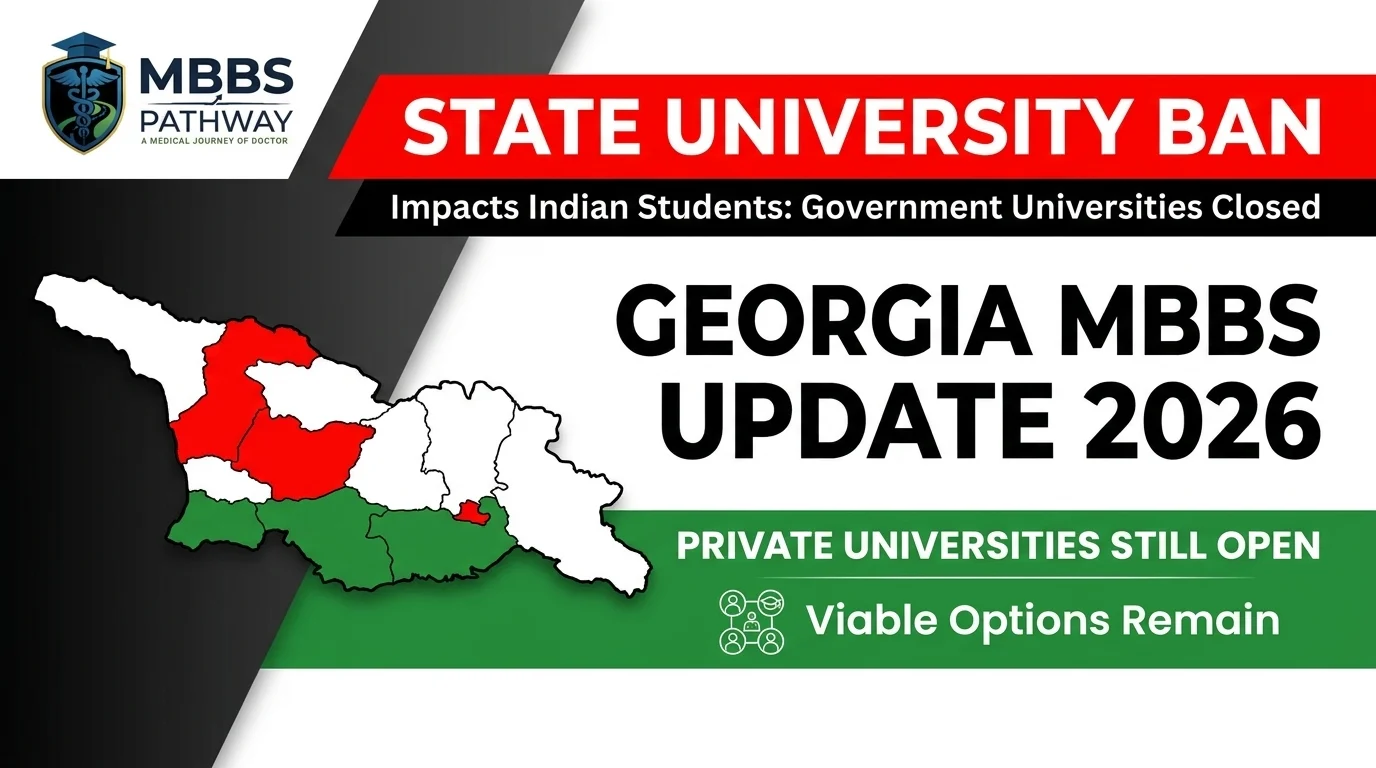
Let's be direct. Georgia's education ministry made an announcement in December 2025 that shook thousands of Indian MBBS aspirants and their parents. State universities — including the well-known Tbilisi State Medical University — are now closed for fresh foreign admissions starting the 2026–27 academic year.
So is Georgia done as a destination? Not entirely. But you need the right information before making a ₹25–40 lakh decision.
In our experience counselling students at MBBS Pathway, we've seen how panic-driven decisions lead to regret. This article gives you only facts — what the ban covers, which private universities are still running, real FMGE data, and honest alternatives. If you want a complete guide to MBBS abroad for Indian students, we've covered that in depth elsewhere. But for Georgia specifically — read this first.
Table of Contents
- What Exactly Is the Georgia MBBS State University Ban? (Facts Only)
- Which Georgian Universities Are Still Open to Indian Students in 2026?
- How Does This Affect Indian Students Already Enrolled in Georgia?
- NMC Recognition Status of Remaining Georgian Private Universities
- FMGE/NExT Pass Rate for Georgia — Real Data (2024 Official Results)
- Should You Still Consider Georgia for MBBS — or Switch to Russia/Uzbekistan?
- Best Alternatives to Georgia MBBS for Indian Students in 2026
- How MBBS Pathway Is Helping Students Navigate the Georgia Situation
- Frequently Asked Questions — Georgia MBBS Ban 2026
- A Note From the MBBS Pathway Team
What Exactly Is the Georgia MBBS State University Ban? (Facts Only)
In December 2025, Georgia's Minister of Education, Science and Youth, Givi Mikanadze, announced an official policy change. The key quote: "Regarding foreign students, certain restrictions will be imposed in state universities from the next academic year. For this purpose, it is planned to introduce legislative amendments, according to which, the admission of foreign students to state universities, except for exceptional cases, will be impossible."
This was not a rumour. It wasn't a WhatsApp forward. It came directly from the Georgian government.
From the 2026–27 academic year, state-run (public) medical universities in Georgia will no longer accept foreign students for new admissions. The Georgian government advanced this policy for two core reasons. First, they want public university resources concentrated on domestic Georgian students. Second, state-funded seats should serve local healthcare workforce needs — a goal Indian policymakers would easily recognise.
What the ban covers:
State or public universities — including Tbilisi State Medical University (TSMU), Batumi Shota Rustaveli State University, and Akaki Tsereteli State University.
What the ban does NOT cover:
Private medical universities in Georgia. These remain fully open to international and Indian students, provided they meet NMC compliance requirements.
This is not a ban on MBBS in Georgia. It's a ban on one category of Georgian universities for foreign students. The distinction matters enormously.
Which Georgian Universities Are Still Open to Indian Students in 2026?
Private medical universities in Georgia are still accepting Indian students for the 2026–27 intake. However, not every private university in Georgia meets NMC's FMGLR 2021 compliance standards. So picking any private university just because it's "open" is a mistake.
Here are the key NMC-compliant private Georgian universities currently accepting Indian students:
| University | City | Annual Fees (USD) | WDOMS Listed | FMGE 2024 Pass Rate |
|---|---|---|---|---|
| Georgian American University | Tbilisi | $6,500 | ✅ Yes | 80.3% |
| Georgian National University SEU | Tbilisi | $6,000 | ✅ Yes | 60.39% |
| BAU International University Batumi | Batumi | $5,800 | ✅ Yes | 63.3% |
| David Tvildiani Medical University (DTMU) | Tbilisi | $7,000 | ✅ Yes | 48.5% |
| Caucasus International University (CIU) | Tbilisi | $5,500 | ✅ Yes | 55.1% |
| Alte University | Tbilisi | $5,500 | ✅ Yes | 46.67% |
| New Vision University | Tbilisi | $6,200 | ✅ Yes | Verify current |
| European University | Tbilisi | $5,000 | ✅ Yes | 35.95% |
Sources: NBEMS FMGE 2024 official data, university websites. Fees are indicative — confirm directly with each university before enrolling.
One critical note: NMC does not publish a formal "approved list" of foreign universities. Instead, your degree is assessed for compliance at the time you apply for registration in India. So the correct question isn't "Is this university NMC-approved?" — it's "Does this university fully comply with FMGLR 2021 rules?" Those rules include a minimum 54-month MBBS programme duration, full internship completed in Georgia (not India), and WDOMS listing. We cover this in full detail in our NMC guidelines for MBBS abroad 2026 page.
Secure Your Medical Future Properly
Don't let regulatory changes jeopardize your career. Talk to our experts to find the best NMC-compliant medical universities abroad for 2026 admissions.
Book Free Counselling NowHow Does This Affect Indian Students Already Enrolled in Georgia?
If you're already studying at a private NMC-compliant university in Georgia, the short answer is: you're fine. The restriction targets new admissions at state universities. Your ongoing education at a private institution is not disrupted.
However, if you enrolled at a state university (like TSMU) before the restriction came into force, your situation needs individual review. Most reports suggest existing enrolled students will be allowed to complete their degree — Georgia's government hasn't retroactively expelled enrolled students. But you should check directly with your university's administration for written confirmation.
If you're a parent of a current student and feeling worried — reach out to us. In our experience, panicking without verified information makes things worse. We'll walk you through exactly what your child's status means in practical terms.
For students applying fresh in 2026, the answer is straightforward. Avoid all state universities in Georgia. Look only at private, WDOMS-listed institutions with a documented FMGE track record.
NMC Recognition Status of Remaining Georgian Private Universities
Let's clear up a common misconception that spreads heavily on YouTube and WhatsApp groups. Many consultants say "this university is NMC-approved" as if it's a permanent badge. It isn't.
NMC operates under the Foreign Medical Graduate Licensing Regulations (FMGLR) 2021. Under this framework, your foreign MBBS is validated case by case at the time you apply for registration in India. Three universities in Georgia were reportedly removed from compliant status in January 2026 — a detail most consultants won't tell you because it hurts their leads.
So the right verification process is this: check nmc.org.in for current guidelines, cross-reference with the WDOMS database, and confirm that your chosen university's programme structure meets the 54-month minimum requirement. Additionally, check that the university permits foreign students to complete their full clinical internship within Georgia — some institutions have restrictions on this that can affect your NMC registration later.
At MBBS Pathway, we maintain a current verified list and update it whenever NMC guidance changes. Book a call and we'll share the latest verification data with you directly.
FMGE/NExT Pass Rate for Georgia — Real Data (2024 Official Results)
This is where Georgia actually stands out — at least for specific private universities. According to official NBEMS FMGE 2024 data, Georgia's overall pass rate was 35.65%. A total of 4,221 Indian students appeared, and 1,505 passed.
But the country average hides a massive gap between universities. Here's what the data actually shows:
- Georgian American University: 80.3% pass rate (49 out of 61 students)
- BAU International University, Batumi: 63.3% (100/158)
- Georgian National University SEU: 60.39%
- Caucasus International University: 55.1% (54/98)
- David Tvildiani Medical University: 48.5%
- Alte University: 46.67% (35/75)
- European University: 35.95%
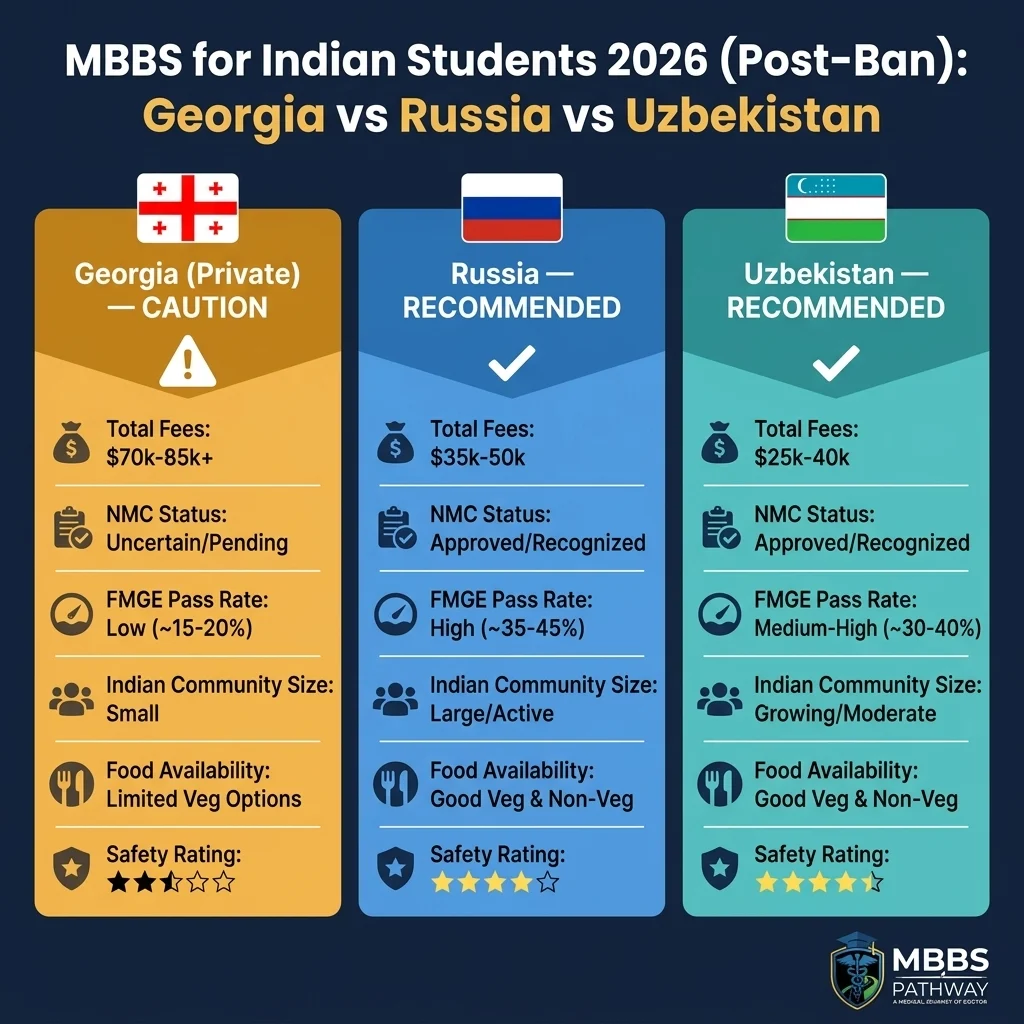
Compare this to FMGE pass rates by country in 2024: Russia came in at 29.54% overall, while Uzbekistan posted an impressive 40.2%. Georgia's top private universities — if you pick the right one — outperform most destinations.
But here's what the averages don't tell you: universities at the bottom of this list are dragging Georgia's overall number down sharply. If you walk into a Georgian private university with a 10–15% FMGE pass rate, that's six years and ₹30–40 lakhs going nowhere near practice in India. University selection is everything here.
Should You Still Consider Georgia for MBBS — or Switch to Russia/Uzbekistan?
We get this question every day now. Here's our honest, advisor-tone take.
If you're looking at state universities in Georgia: No. Do not apply. The ban is firm, and no consultant can work around it.
If you're looking at top-performing private universities in Georgia — Georgian American University, BAU International, Georgian National University SEU, Caucasus International — then Georgia still makes sense. Their FMGE numbers are genuinely strong, fees are reasonable at $5,500–$7,000 per year, Tbilisi is a safe and liveable city for Indian students, and the English-medium curriculum aligns closely with the Indian MBBS pattern.
However, you're now operating with less margin for error. The regulatory environment has shifted. Any future policy change affecting private universities would directly impact you, and that risk didn't exist two years ago.
On the other hand, Russia has been sending students abroad since the 1980s. With 60+ universities, a 29.54% overall FMGE rate (and top Russian universities crossing 50%), and one of the largest Indian student communities outside India — Russia is the dependable choice. If certainty matters more than cost optimisation, Russia wins.
Uzbekistan is the surprise of 2024's FMGE data. A 40.2% overall pass rate — better than Georgia and Russia combined — at total programme costs of ₹18–25 lakhs. The Indian student community in Uzbekistan is growing fast, and the country has established NMC-compliant universities at Tashkent, Samarkand, and Bukhara.
We've written detailed country guides. Use them to compare directly.
Best Alternatives to Georgia MBBS for Indian Students in 2026
Russia — The Established Choice
Russia has over 60 NMC-compliant medical universities. The overall FMGE 2024 pass rate was 29.54%, but top institutions like Kazan State Medical University and Sechenov University perform significantly above that. Total programme cost ranges from ₹25–35 lakhs. Russian cities like Kazan, Volgograd, and Voronezh have large, well-established Indian student communities with Indian mess facilities, cultural events, and strong peer support networks. If you're a first-time student going abroad, Russia offers the most complete support ecosystem.
Read our full MBBS in Russia for Indian students — complete 2026 guide for university-level comparisons.
Uzbekistan — The Rising Star
Nobody predicted Uzbekistan would post a 40.2% FMGE pass rate in 2024. But it did. Total programme costs of ₹18–25 lakhs make it the most affordable genuine option on this list. Tashkent Medical Academy, Samarkand State Medical University, and Bukhara State Medical Institute have all shown consistent improvement. The Indian student community is smaller than Russia's but growing quickly, and the government has been actively improving university infrastructure.
See full details in our MBBS in Uzbekistan fees and details 2026 guide.
Kazakhstan — Emerging, English-Medium
Kazakhstan deserves a mention. Several universities offer MBBS programmes in English, fees are affordable (similar to Uzbekistan), and FMGE performance has been improving. It's not our first recommendation for 2026 — but if your budget is tight and you want English-medium teaching in a stable country, Kazakhstan is worth considering. Check out our MBBS in Kazakhstan & Kyrgyzstan page for full details.
How MBBS Pathway Is Helping Students Navigate the Georgia Situation
We want to be transparent about something. Several consultants in India are still pushing Georgia state university applications because they don't want to lose the leads. We're not doing that. In our experience, hiding information from students to protect our booking numbers is not how you build trust — and it's not how you build careers.
So here's exactly what MBBS Pathway is doing right now:
First, we're advising every student enquiring about Georgia to stay away from state universities entirely for 2026–27. Second, for students interested in Georgia's private university route, we're providing verified FMGE data by university, not country averages, so families can make a real comparison. Third, we're actively presenting Russia and Uzbekistan as the primary recommendations for new admissions in 2026, because the data supports them.
We're also helping families who already applied to Georgian state universities understand what their actual options are — whether to redirect to a private Georgian university, switch country, or in some cases wait for clarity from the Georgian government.
If you're unsure what this ban means for your specific situation, book a free counselling session with our team. No upselling. No pushing a particular country. Just the information you need to make a sound decision.
📞 Call / WhatsApp: +91 88266 53638
📧 Email: info@mbbspathway.in
Frequently Asked Questions — Georgia MBBS Ban 2026
Is Georgia MBBS banned for Indian students in 2026?
Not completely. Georgia has restricted new foreign student admissions at state (public) universities starting 2026–27. Several NMC-compliant private Georgian universities are still fully open to Indian students. Verify each university's WDOMS listing and FMGLR 2021 compliance before applying.
Which Georgian universities are still open for Indian students in 2026?
David Tvildiani Medical University (DTMU), Georgian American University, Georgian National University SEU, BAU International University Batumi, Caucasus International University, Alte University, New Vision University, and European University are among the private institutions currently accepting Indian students. Confirm directly with each institution for the 2026–27 intake status.
What happens to Indian students already studying MBBS in Georgia?
Students already enrolled at NMC-compliant private Georgian universities are unaffected. They can continue their MBBS programme normally. The ban applies to new admissions at state-run universities only. If you're currently at a state university, seek written confirmation from your institution about your continuing enrolment status.
Is it safe to join a Georgian private university for MBBS in 2026?
It depends on the university. Georgia's top private universities — Georgian American University (80.3% FMGE 2024), BAU International (63.3%), Georgian National SEU (60.39%) — show genuinely strong outcomes. However, given the regulatory shift, the risk profile has increased compared to prior years. Russia and Uzbekistan offer greater stability for 2026 new admissions.
What is Tbilisi State Medical University's status after the ban?
Tbilisi State Medical University is a state institution and is directly affected by the 2026 foreign admissions restriction. TSMU is not accepting new Indian students for the 2026–27 intake. If you were planning to apply to TSMU, switch your target to one of the private institutions listed above or consider Russia/Uzbekistan alternatives.
What is the FMGE pass rate for Georgian MBBS graduates?
Georgia's overall FMGE 2024 pass rate was 35.65% (1,505 of 4,221 students). Top university-wise results: Georgian American University 80.3%, BAU International Batumi 63.3%, Georgian National SEU 60.39%, Caucasus International University 55.1%, David Tvildiani Medical University 48.5%. University selection dramatically changes your outcomes — country average alone is misleading.
Should I choose Georgia or Russia for MBBS in 2026?
For new admissions in 2026, Russia is the more stable and established choice. Russia has a proven 40+ year track record, 60+ compliant universities, and a 29.54% overall FMGE rate with top institutions performing significantly higher. Georgia's best private universities beat Russia's average — but regulatory uncertainty in Georgia adds a risk factor that didn't exist before 2026.
What are the best alternatives to Georgia MBBS in 2026?
Top three alternatives: Russia (₹25–35L total, 29.54% FMGE, large Indian community), Uzbekistan (₹18–25L total, 40.2% FMGE 2024, most affordable option), Kazakhstan (affordable, English medium, improving FMGE). All three have WDOMS-listed, NMC-compliant universities with verifiable FMGE track records.
Can I transfer from a Georgian university to a Russian university mid-MBBS?
Generally no — not easily, and not recommended. Mid-course transfers across countries require approval from both universities, NMC equivalence review, and are typically only feasible from Year 1 or early Year 2. The NMC banned lateral entry into Indian medical colleges in 2018, so completing your degree in the country you started is mandatory. Proper counselling before enrollment prevents this situation.
How can MBBS Pathway help with the Georgia MBBS situation?
MBBS Pathway offers transparent, one-on-one counselling — we'll tell you exactly which Georgian private universities have strong FMGE data, whether Russia or Uzbekistan suits your NEET score and budget better, and what your options look like in your specific situation. Book a free 30-minute call and we'll walk you through the numbers honestly.
Does the Georgia MBBS ban affect students who applied before 2026?
The restriction targets new admissions for the 2026–27 academic year and beyond. Students who completed state university admission before this intake period may be in a different situation. If you applied before the restriction came into force, contact your university for written confirmation of your enrolment status, and reach out to us for an independent assessment.
Is a degree from a Georgian private university still valid in India after the ban?
Yes — provided the private university fully complies with NMC's FMGLR 2021 rules. This means: minimum 54-month MBBS programme, internship completed within Georgia (not transferred to India mid-course), and the university listed in WDOMS. The state university ban does not invalidate degrees from NMC-compliant private institutions. Your degree's validity is tied to compliance, not to where the ban falls.
A Note From the MBBS Pathway Team
We run MBBS Pathway out of Gurugram. Every student who walks into our office — or calls us from Kolkata, Patna, Jaipur, or Hyderabad at 10 PM — gets the same answer: the truth, not what makes our commission easiest to collect.
The Georgia situation is manageable. It's not a crisis if you make a clear-headed decision right now. The private university route in Georgia still works — but only with the right university, verified data, and eyes wide open about the new regulatory environment.
And if Georgia doesn't feel right to you anymore, Russia and Uzbekistan are genuinely strong options with real data to back them up.
We're here. Call us. No pressure.
📞 +91 88266 53638 | 📧 info@mbbspathway.in | 🌐 mbbspathway.in/contact-us/